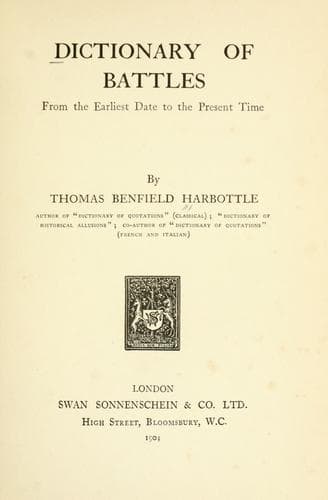
Dictionary of Battles: From the Earliest Date to the Present TimeHarbottle, Thomas Benfield
History
Dictionary of Battles: From the Earliest Date to the Present Time
Harbottle, Thomas Benfield
Battles
Fought B.C. 470, between the Persian fleet and army, and the Athenians
and Delians, under Cimon. The Greeks were victorious both by land and
sea, defeating the Persian fleet with a loss of 200 ships, and routing
the land army with great slaughter. This victory secured the adhesion of
the south of Asia Minor to the Athenian Confederacy.
Evesham (Barons’ War).
Fought August 4, 1265, between the royalists under Prince Edward, and
the Barons under Simon de Montfort. The Barons were taken by surprise,
having at first mistaken Edward’s army for reinforcements under young de
Montfort, and were totally defeated, Simon de Montfort falling. This
defeat ended the Barons’ War.
Eylau (Campaign of Friedland).
Fought February 8, 1807, between 90,000 French under Napoleon, and
80,000 Russians under Bennigsen. Napoleon attacked at daybreak, all
along the line, but could at first make no impression on the Russian
infantry. Later in the day Davoust all but succeeded in turning the
Russian left, but the opportune arrival of a Prussian corps under
l’Estocq enabled the Russians to repulse him, and after a sanguinary
engagement, which lasted till ten p.m., both armies retained their
original positions. On the following day the Russians retired
unmolested. The French lost about 30,000; the Russians about 20,000
killed and wounded.
F
Faenza (First Gothic War).
Fought 541, between 20,000 Roman legionaries, and the Goths under
Totila, King of Italy. The Romans made no attempt to resist the
onslaught of the Goths, but throwing down their arms fled ignominiously,
giving the Goths an easy victory.
Fair Oaks (American Civil War).
Fought May 31, and June 1, 1862, between the Federals under General
M’Clellan and the Confederates under General Johnston. M’Clellan was
advancing upon Richmond, and his left wing was attacked in the afternoon
of the 31st, and notwithstanding the arrival of Sumner’s corp in
support, was driven back for two miles. On the 1st the Federals
recovered the ground they had lost, but made no further progress, and at
the end of the day the Confederates, who were largely outnumbered, were
permitted to retire unmolested. The Federals lost over 7,000 killed and
wounded, the Confederates about 4,500, including General Johnston. This
is also called the Battle of Seven Pines.
Falkirk (Scottish Wars).
Fought July 23, 1298, between the English under Edward I, and the Scots
under Sir William Wallace. The Scots, who were greatly inferior in
numbers, were strongly posted behind a morass, which at first greatly
hampered the English attack. In the end, however, the English archers
overcame the Scottish defence, and a final charge, led by the king in
person, utterly routed them. Wallace escaped from the field, but was a
fugitive for the rest of his life.
Public-domain text, read in full here on John Shaqi.
Reviews
Reviews
No reviews yet
Be the first to share your thoughts on this work.
Elsewhere in the archive
Join the Discussion
Join the discussion
Sign in to leave a comment or review.
Sign InorCreate an account