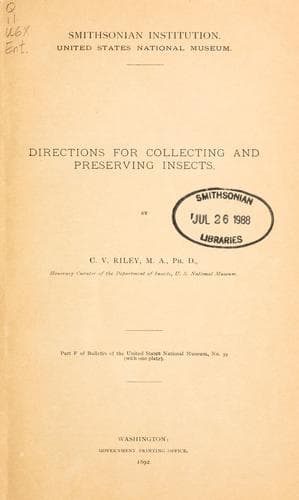
Directions for Collecting and Preserving InsectsRiley, Charles V. (Charles Valentine)
Science
Directions for Collecting and Preserving Insects
Riley, Charles V. (Charles Valentine)
Insects -- Collection and preservation
Insects the larvae of which live in wood are particularly subject to
verdigris, as the Cerambycidae and Elateridae in Coleoptera, the Uroceridae
in Hymenoptera and Sesiidae in Lepidoptera. In Hymenoptera the families
Formicidae, Mutillidae, and the endophytous Tenthredinidae verdigris very
rapidly, and most Diptera also. With all these insects japanned or
silvered pins should be used, or when not too large the insects should
be mounted on triangles. This verdigrising is associated with what is
known as greasing, and this, as just indicated, is also associated with
endophytous larval life. The verdigris may be prevented by the methods
indicated, and I would strongly advise, as a good general rule to be
followed, the rejection of the ordinary pins for all species which, in
the larva state, are internal feeders. But there is no way of preventing
greasing or decomposition of the fats of the body, which may affect a
specimen years after it has been in the cabinet. If the specimen is
valuable the grease may be absorbed by immersion in ether or benzine, or
by a longer treatment with powdered pipe-clay or plaster of Paris.
Insects collected on seabeaches, and saturated with salt water, also
corrode the common steel pin very quickly and should be mounted on
japanned pins. It is also advisable to rinse such specimens thoroughly
in fresh water before mounting.
The conviction has been forcing itself on my mind for some time that the
naphthaline cones tend to promote greasing and verdigris, and carbolic
acid in some small vessel secured to the cork, were, perhaps,
preferable.
THE REARING OF INSECTS.
_General Directions._--The importance, even to the mere collector, of
rearing insects to obtain specimens for the cabinet has been referred to
from time to time in these pages. The philosophic study of entomology,
however, requires much more than the mere collecting of specimens, and
one of the most profitable and, at the same time, most fascinating
phases of the study relates to the life-history and habits. In no branch
of natural history are biologic studies more easily carried on, or the
biologic facts more remarkable or interesting. The systematist by such
study will be saved from the narrow and hair-splitting tendencies which
study of slight difference of characters tends to, while to the economic
entomologist it is most essential.
In the rearing of insects success will be attained in proportion to the
extent to which the conditions of nature in the matters of temperature,
moisture, food-supply, and conditions for pupation, are observed.
Public-domain text, read in full here on John Shaqi.
Reviews
Reviews
No reviews yet
Be the first to share your thoughts on this work.
Elsewhere in the archive
Join the Discussion
Join the discussion
Sign in to leave a comment or review.
Sign InorCreate an account