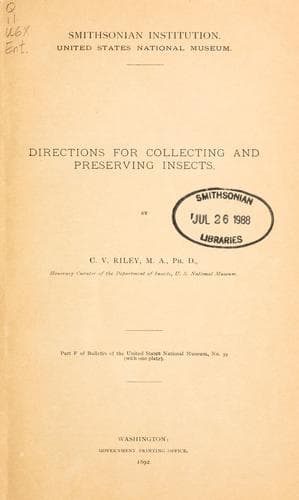
Directions for Collecting and Preserving InsectsRiley, Charles V. (Charles Valentine)
Science
Directions for Collecting and Preserving Insects
Riley, Charles V. (Charles Valentine)
Insects -- Collection and preservation
In the foregoing pages are given some of the more useful directions for
those wishing to commence to collect and study insects. Experience will
soon teach many other important facts not mentioned here, and the best
closing advice I can give the novice is, to get acquainted, if possible,
with some one who has already had large experience. He will be very apt
to find such a person pleasant and instructive company whether in the
field or in the closet. One important habit, however, I wish to strongly
inculcate and emphasize: The collector should never be without his
memorandum or note book. More profitless work can scarcely be imagined
than collecting natural-history specimens without some specific aim or
object. Every observation made should be carefully recorded, and the
date of capture, locality, and food-plant should always be attached to
the specimens when these are mounted. More extended notes may be made in
a field memorandum book carried in the pocket or in larger record books
at home. For field memoranda I advise the use of a stylographic pen, as
pencil is apt to rub and efface in time by the motions of the body. The
larger record book is especially necessary for biologic notes. Notes on
adolescent states which it is intended to rear to the imago can not be
too carefully made or in too much detail. The relative size, details of
ornamentation and structure, dates of moulting or transformation from
one state to another--indeed, everything that pertains to the biography
of the species--should be noted down, and little or nothing trusted to
mere memory where exact data are so essential. Many insects,
particularly dragon-flies, have brilliant coloring when fresh from the
pupa, which is largely lost afterward. The time of laying and hatching
of eggs, the number from a single female, the character of the eggs,
general habits, records of parasites and their mode of attack--all
should be entered as observed. A great many species have the most
curious life histories, which can not be ascertained except by continued
and persevering observation, not only in the vivarium or insectary but
in the field. It is almost impossible to follow, under artificial
conditions, the full life cycle of many species like the Aphididae, or
the Gall-flies, etc., which involve alternation of generations,
dimorphism, heteromorphism, migration from one plant to another, and
various other curious departures from the normal mode of development,
without careful field study and experiment. These studies are possible
only to those who are able to frequent the same localities throughout
the whole year, and can hardly be carried on by the traveling naturalist
or collector.
INSTRUCTIONS FOR COLLECTING AND PRESERVING ARACHNIDS AND MYRIAPODS.
Public-domain text, read in full here on John Shaqi.
Reviews
Reviews
No reviews yet
Be the first to share your thoughts on this work.
Elsewhere in the archive
Join the Discussion
Join the discussion
Sign in to leave a comment or review.
Sign InorCreate an account