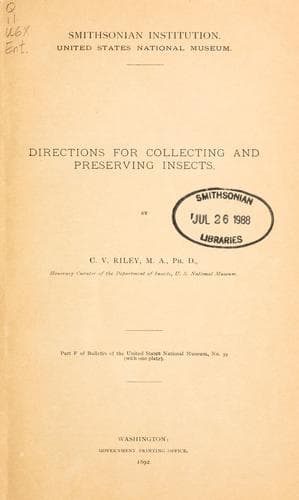
Directions for Collecting and Preserving InsectsRiley, Charles V. (Charles Valentine)
Science
Directions for Collecting and Preserving Insects
Riley, Charles V. (Charles Valentine)
Insects -- Collection and preservation
of Locusts (_Acrididae_), they are apt to exude colored juices from the
mouth, so that the specimens become soiled. Hence the use of vials of
alcohol is preferable, and these insects should never be thrown into
vials containing delicate insects of other orders. Plant-lice, together
with the plant which they infest, should be placed at once in vials of
alcohol, and specimens of the Aphides, representing all the forms
present, should be mounted on slides for microscopic examination. The
fixed forms of Coccids, comprising the majority of the species, require
no special treatment, and the leaves, twigs, or bark on which they occur
may be pinned at once and placed in the collection. The free forms are
treated as in the case of plant-lice.
ENTOMOTAXY.
Under this term may be considered the preparation of insects for the
cabinet.
CARE OF PINNED AND MOUNTED SPECIMENS.
_Insect Pins._--In mounting insects for the cabinet, expressly made
entomological pins should be used. These come from three different
sources: Klaeger pins, made by Hermann Klaeger, Berlin, Germany; Karlsbad
pins, made by one or several firms in Karlsbad, Bohemia, Austria; and
Vienna pins, made by Miller, Vienna, Austria.[4] These three kinds of
pins have each their own slight advantages and disadvantages, so that it
is difficult to say which is the best. All have the disadvantage that
the pinned specimens are liable to be ruined by verdigris, and to
obviate this japanned ("black") insect pins are made by Klaeger and
Miller. These black pins are, however, much softer than the "white"
pins, and therefore more difficult to handle. A pin of 35 millimeters in
length will be found most convenient for pinning all insects excepting
the larger Lepidoptera and other heavy-bodied insects, for which a
longer pin may advantageously be used. According to the different
degrees of fineness, the pins are numbered from No. 00 (the finest in
the trade) to No. 7 or 8, but the numbers used by the different
manufacturers do not correspond with each other. In experience, pins of
Nos. 1, 2, 3, and 4 (Klaeger numbers) are more often needed than the
others. The long pins of the finer numbers (Nos. 0 and 00) are difficult
to handle in the collection and, for this reason, not to be recommended.
[4] In North America, Klaeger pins and Karlsbad pins can be obtained
through Mr. John Ackhurst, 78 Ashland Place, Brooklyn, N. Y., and
possibly also through Messrs. Blake & Co., 55 North Seventh street,
Philadelphia, Pa. The Vienna pins and the Minutien-Nadeln have to be
ordered direct through the manufacturer, Mr. Miller.
Public-domain text, read in full here on John Shaqi.
Reviews
Reviews
No reviews yet
Be the first to share your thoughts on this work.
Elsewhere in the archive
Join the Discussion
Join the discussion
Sign in to leave a comment or review.
Sign InorCreate an account