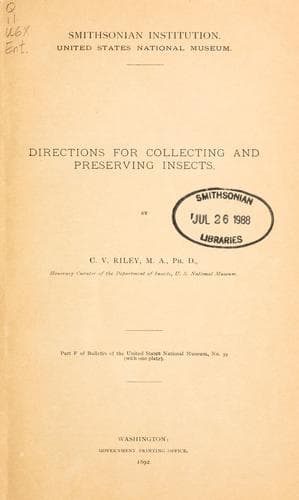
Directions for Collecting and Preserving InsectsRiley, Charles V. (Charles Valentine)
Science
Directions for Collecting and Preserving Insects
Riley, Charles V. (Charles Valentine)
Insects -- Collection and preservation
The advantages of this system are the ease and security with which the
block can be placed in or removed from a box; the ease with which a vial
can be slipped into or removed from the wire clamps; the security with
which it is held, and the fact that practically no part of the contents
of the vial is obscured by the holder--the whole being visible from
above.
The beveled ends of the block may be used for labeling, or pieces of
clean cardboard cut so as to project somewhat on all sides may be used
for this purpose, and will be held secure by the pins between the block
and the cork of the drawers.
[Illustration: FIG. 112.--Vial holder; 1, block, with vial, beveled on
all sides; 2, do., beveled only on ends; 3, block, end view; 5, do.,
section; 4, 6, do., side views; _a_, block; _b_, spring-wire clamps;
_c_, beveled ends of block; _d_, pointed wire nails; _e_, point of
insertion of clamp. (Lettering on all figures corresponds.)]
The use of rubber stoppers in this country was first instituted by Dr.
H. A. Hagen in connection with the Cambridge biological collection, and
he has made some very careful records to determine the durability of
such stoppers. From an examination of some seven thousand vials with
rubber stoppers, two-thirds of which had been in use for from ten to
twelve years, he comes to the conclusion that less than one in a
thousand gives out every year after twelve years' use, and in the first
six years probably only one out of two thousand. Stoppers of large size
keep much longer than those of small size. American rubber stoppers are
all made of vulcanized India rubber and have the disadvantage of forming
small crystals of sulphur about the stopper, which become loosened and
attach themselves to the specimens. It is supposed that pure
rubber-stoppers used for chemical purposes would not present this
disadvantage, which may be obviated, however, or very much reduced, if
the stoppers are washed or soaked, preferably in hot water, for an hour
or two at least.
If stoppers are stored for a considerable time and exposed to the air
they become very hard and unfit for use, and Dr. Hagen has drawn
attention to a method recommended by Professor W. Hemple, of Dresden,
Saxony, of preventing them from becoming thus hardened. He says that to
keep rubber stoppers or rubber apparatus of any sort elastic, they
should be stored in large glass jars in which an open vessel containing
petroleum is placed. This treatment prevents the evaporation of the
fluids which are fixed in the rubber in the process of vulcanization. It
is better also to keep the light from the jar. To soften stoppers which
have already become hardened, they should be brought together in a jar
with sulphuret of carbon until they are pliable and afterward kept as
recommended above.
Public-domain text, read in full here on John Shaqi.
Reviews
Reviews
No reviews yet
Be the first to share your thoughts on this work.
Elsewhere in the archive
Join the Discussion
Join the discussion
Sign in to leave a comment or review.
Sign InorCreate an account