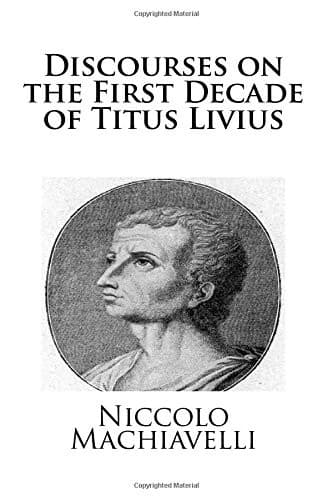
Discourses on the First Decade of Titus LiviusMachiavelli, Niccolò
Philosophy
Discourses on the First Decade of Titus Livius
Machiavelli, Niccolò
Livy. Ab urbe condita; Political science -- Early works to 1800; Rome -- Historiography
It has been seen in the preceding chapter how much credit the nobles
gained with the commons by a show of good-will towards them, not only
in providing for their military pay, but also in adjusting taxation.
Had the senate constantly adhered to methods like these, they would
have put an end to all disturbances in Rome, and have deprived the
tribunes of the credit they had with the people, and of the influence
thence arising. For in truth, in a commonwealth, and especially in one
which has become corrupted, there is no better, or easier, or less
objectionable way of opposing the ambition of any citizen, than to
anticipate him in those paths by which he is seen to be advancing to
the ends he has in view. This plan, had it been followed by the enemies
of Cosimo de’ Medici, would have proved a far more useful course for
them than to banish him from Florence; since if those citizens who
opposed him had adopted his methods for gaining over the people, they
would have succeeded, without violence or tumult, in taking his most
effective weapon from his hands.
The influence acquired in Florence by Piero Soderini was entirely due
to his skill in securing the affections of the people, since in this
way he obtained among them a name for loving the liberties of the
commonwealth. And truly, for those citizens who envied his greatness it
would have been both easier and more honourable, and at the same time
far less dangerous and hurtful to the State, to forestall him in those
measures by which he was growing powerful, than to oppose him in such a
manner that his overthrow must bring with it the ruin of the entire
republic. For had they, as they might easily have done, deprived him of
the weapons which made him formidable, they could then have withstood
him in all the councils, and in all public deliberations, without
either being suspected or feared. And should any rejoin that, if the
citizens who hated Piero Soderini committed an error in not being
beforehand with him in those ways whereby he came to have influence
with the people, Piero himself erred in like manner, in not
anticipating his enemies in those methods whereby they grew formidable
to him; I answer that Piero is to be excused, both because it would
have been difficult for him to have so acted, and because for him such
a course would not have been honourable. For the paths wherein his
danger lay were those which favoured the Medici, and it was by these
that his enemies attacked him, and in the end overthrew him. But these
paths Piero could not pursue without dishonour, since he could not, if
he was to preserve his fair fame, have joined in destroying that
liberty which he had been put forward to defend. Moreover, since
favours to the Medicean party could not have been rendered secretly and
once for all, they would have been most dangerous for Piero, who, had
he shown himself friendly to the Medici, must have become suspected and
hated by the people; in which case his enemies would have had still
Public-domain text, read in full here on John Shaqi.
Reviews
Reviews
No reviews yet
Be the first to share your thoughts on this work.
Elsewhere in the archive
Join the Discussion
Join the discussion
Sign in to leave a comment or review.
Sign InorCreate an account