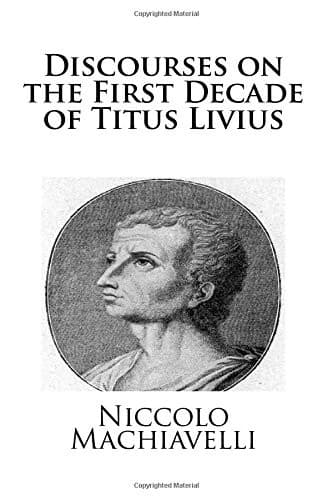
Discourses on the First Decade of Titus LiviusMachiavelli, Niccolò
Philosophy
Discourses on the First Decade of Titus Livius
Machiavelli, Niccolò
Livy. Ab urbe condita; Political science -- Early works to 1800; Rome -- Historiography
And since leagues and alliances are broken for the sake of certain
advantages, in this respect also, commonwealths observe their
engagements far more faithfully than princes; for abundant examples
might be cited of a very slight advantage having caused a prince to
break faith, and of a very great advantage having failed to induce a
commonwealth to do so. Of this we have an instance in the proposal made
to the Athenians by Themistocles, when he told them at a public meeting
that he had certain advice to offer which would prove of great
advantage to their city, but the nature of which he could not disclose
to them, lest it should become generally known, when the opportunity
for acting upon it would be lost. Whereupon the Athenians named
Aristides to receive his communication, and to act upon it as he
thought fit. To him, accordingly, Themistocles showed how the navy of
united Greece, for the safety of which the Athenians stood pledged, was
so situated that they might either gain it over or destroy it, and thus
make themselves absolute masters of the whole country. Aristides
reporting to the Athenians that the course proposed by Themistocles was
extremely advantageous but extremely dishonourable, the people utterly
refused to entertain it. But Philip of Macedon would not have so acted,
nor any of those other princes who have sought and found more profit in
breaking faith than in any other way.
As to engagements broken off on the pretext that they have not been
observed by the other side, I say nothing, since that is a matter of
everyday occurrence, and I am speaking here only of those engagements
which are broken off on extraordinary grounds; but in this respect,
likewise, I believe that commonwealths offend less than princes, and
are therefore more to be trusted.
CHAPTER LX.—_That the Consulship and all the other Magistracies in Rome
were given without respect to Age_.
It is seen in the course of the Roman history that, after the
consulship was thrown open to the commons, the republic conceded this
dignity to all its citizens, without distinction either of age or
blood; nay, that in this matter respect for age was never made a ground
for preference among the Romans, whose constant aim it was to discover
excellence whether existing in old or young. To this we have the
testimony of Valerius Corvinus, himself made consul in his
twenty-fourth year, who, in addressing his soldiers, said of the
consulship that it was “_the reward not of birth but of desert_.”
Public-domain text, read in full here on John Shaqi.
Reviews
Reviews
No reviews yet
Be the first to share your thoughts on this work.
Elsewhere in the archive
Join the Discussion
Join the discussion
Sign in to leave a comment or review.
Sign InorCreate an account