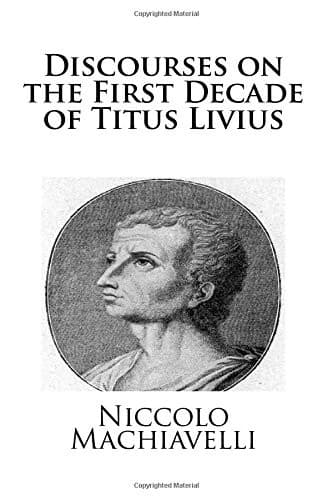
Discourses on the First Decade of Titus LiviusMachiavelli, Niccolò
Philosophy
Discourses on the First Decade of Titus Livius
Machiavelli, Niccolò
Livy. Ab urbe condita; Political science -- Early works to 1800; Rome -- Historiography
Under such circumstances the number of the inhabitants of that State
could never much increase. For as all our actions imitate nature, and
it is neither natural nor possible that a puny stem should carry a
great branch, so a small republic cannot assume control over cities or
countries stronger than herself; or, doing so, will resemble the tree
whose boughs being greater than its trunk, are supported with
difficulty, and snapped by every gust of wind. As it proved with
Sparta. For after she had spread her dominion over all the cities of
Greece, no sooner did Thebes rebel than all the others rebelled
likewise, and the trunk was left stripped of its boughs. But this could
not have happened with Rome, whose stem was mighty enough to bear any
branch with ease.
It was, therefore, by adding to her population, and by, adopting
certain other methods presently to be noticed, that Rome became so
great and powerful. And this is well expressed by Titus Livius, in the
words, “_Crescit interea Roma Albae ruinis_.”
CHAPTER IV.—_That Commonwealths have followed three Methods for
extending their Power_.
Any one who has read ancient history with attention, must have observed
that three methods have been used by republics for extending their
power. One of these, followed by the old Etruscans, is to form a
confederation of many States, wherein none has precedence over the rest
in authority or rank, and each allows the others to share its
acquisitions; as do the States of the Swiss League in our days, and as
the Achaians and Etolians did in Greece in earlier times. And because
the Etruscans were opposed to the Romans in many wars, that I may give
a clearer notion of this method of theirs, I shall enlarge a little in
my account of the Etruscan people.
Public-domain text, read in full here on John Shaqi.
Reviews
Reviews
No reviews yet
Be the first to share your thoughts on this work.
Elsewhere in the archive
Join the Discussion
Join the discussion
Sign in to leave a comment or review.
Sign InorCreate an account