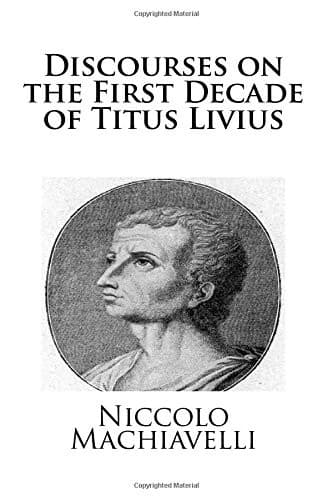
Discourses on the First Decade of Titus LiviusMachiavelli, Niccolò
Philosophy
Discourses on the First Decade of Titus Livius
Machiavelli, Niccolò
Livy. Ab urbe condita; Political science -- Early works to 1800; Rome -- Historiography
Without such an army no amount of money will meet your wants, the
natural strength of your country will not protect you, and the fidelity
and attachment of your subjects will not endure, since it is impossible
that they should continue true to you when you cannot defend them.
Lakes, and mountains, and the most inaccessible strongholds, where
valiant defenders are wanting, become no better than the level plain;
and money, so far from being a safeguard, is more likely to leave you a
prey to your enemy; since nothing can be falser than the vulgar opinion
which affirms it to be the sinews of war.
This opinion is put forward by Quintus Curtius, where, in speaking of
the war between Antipater the Macedonian and the King of Sparta, he
relates that the latter, from want of money, was constrained to give
battle and was defeated; whereas, could he have put off fighting for a
few days the news of Alexander’s death would have reached Greece, and
he might have had a victory without a battle. But lacking money, and
fearing that on that account his soldiers might desert him, he was
forced to hazard an engagement. It was for this reason that Quintus
Curtius declared money to be the sinews of war, a maxim every day cited
and acted upon by princes less wise than they should be. For building
upon this, they think it enough for their defence to have laid up great
treasures; not reflecting that were great treasures all that is needed
for victory, Darius of old had conquered Alexander, the Greeks the
Romans, and in our own times Charles of Burgundy the Swiss; while the
pope and the Florentines together would have had little difficulty in
defeating Francesco Maria, nephew of Pope Julius II., in the recent war
of Urbino; and yet, in every one of these instances, the victory
remained with him who held the sinews of war to consist, not in money,
but in good soldiers.
Croesus, king of Lydia, after showing Solon the Athenian much besides,
at last displayed to him the boundless riches of his treasure-house,
and asked him what he thought of his power. Whereupon Solon answered
that he thought him no whit more powerful in respect of these
treasures, for as war is made with iron and not with gold, another
coming with more iron might carry off his gold. After the death of
Alexander the Great a tribe of Gauls, passing through Greece on their
way into Asia, sent envoys to the King of Macedonia to treat for terms
of accord; when the king, to dismay them by a display of his resources,
showed them great store of gold and silver. But these barbarians, when
they saw all this wealth, in their greed to possess it, though before
they had looked on peace as settled, broke off negotiations; and thus
the king was ruined by those very treasures he had amassed for his
defence. In like manner, not many years ago, the Venetians, with a full
treasury, lost their whole dominions without deriving the least
advantage from their wealth.
Public-domain text, read in full here on John Shaqi.
Reviews
Reviews
No reviews yet
Be the first to share your thoughts on this work.
Elsewhere in the archive
Join the Discussion
Join the discussion
Sign in to leave a comment or review.
Sign InorCreate an account