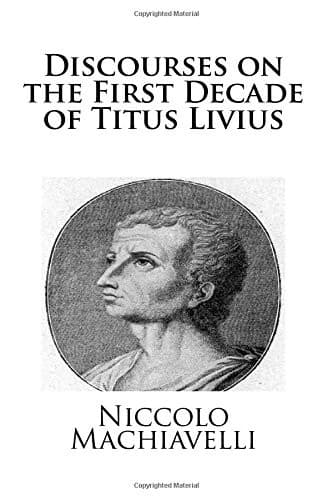
Discourses on the First Decade of Titus LiviusMachiavelli, Niccolò
Philosophy
Discourses on the First Decade of Titus Livius
Machiavelli, Niccolò
Livy. Ab urbe condita; Political science -- Early works to 1800; Rome -- Historiography
With very few cavalry, but with a considerable force of infantry, the
Roman commanders, Crassus and Marcus Antonius, each for many days
together overran the territories of the Parthians, although opposed by
the countless horsemen of that nation. Crassus, indeed, with the
greater part of his army, was left there dead, and Antonius only saved
himself by his valour; but even in the extremities to which the Romans
were then brought, see how greatly superior foot-soldiers are to horse.
For though fighting in an open country, far from the sea-coast, and cut
off from his supplies, Antonius proved himself a valiant soldier in the
judgment even of the Parthians themselves, the whole strength of whose
cavalry never ventured to attack the columns of his army. And though
Crassus perished there, any one who reads attentively the account of
his expedition must see that he was rather outwitted than defeated, and
that even when his condition was desperate, the Parthians durst not
close with him, but effected his destruction by hanging continually on
the flanks of his army, and intercepting his supplies, while cajoling
him with promises which they never kept.
It might, I grant, be harder to demonstrate this great superiority of
foot over horse, had we not very many modern examples affording the
clearest proof of it. For instance, at the battle of Novara, of which
we have already spoken, nine thousand Swiss foot were seen to attack
ten thousand cavalry together with an equal number of infantry, and to
defeat them; the cavalry being powerless to injure them, while of the
infantry, who were mostly Gascons, and badly disciplined, they made no
account. On another occasion we have seen twenty-six thousand Swiss
march on Milan to attack Francis I. of France, who had with him twenty
thousand men-at-arms, forty thousand foot, and a hundred pieces of
artillery; and although they were not victorious as at Novara, they
nevertheless fought valiantly for two days together, and, in the end,
though beaten, were able to bring off half their number. With
foot-soldiers only Marcus Attilius Regulus ventured to oppose himself,
not to cavalry merely, but to elephants; and if the attempt failed it
does not follow that he was not justified by the valour of his men in
believing them equal to surmount this danger.
Public-domain text, read in full here on John Shaqi.
Reviews
Reviews
No reviews yet
Be the first to share your thoughts on this work.
Elsewhere in the archive
Join the Discussion
Join the discussion
Sign in to leave a comment or review.
Sign InorCreate an account