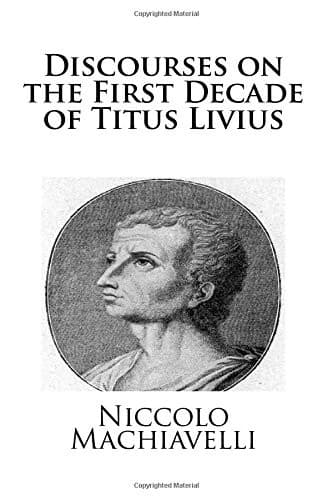
Discourses on the First Decade of Titus LiviusMachiavelli, Niccolò
Philosophy
Discourses on the First Decade of Titus Livius
Machiavelli, Niccolò
Livy. Ab urbe condita; Political science -- Early works to 1800; Rome -- Historiography
Those States consequently stand surest and endure longest which, either
by the operation of their institutions can renew themselves, or come to
be renewed by accident apart from any design. Nothing, however, can be
clearer than that unless thus renewed these bodies do not last. Now the
way to renew them is, as I have said, to bring them back to their
beginnings, since all beginnings of sects, commonwealths, or kingdoms
must needs have in them a certain excellence, by virtue of which they
gain their first reputation and make their first growth. But because in
progress of time this excellence becomes corrupted, unless something be
done to restore it to what it was at first, these bodies necessarily
decay; for as the physicians tell us in speaking of the human body,
“_Something or other is daily added which sooner or later will require
treatment._”[10]
[10] “Quod quotidie aggregatur aliquid quod quandoque indiget
curatione.”
As regards commonwealths, this return to the point of departure is
brought about either by extrinsic accident or by intrinsic foresight.
As to the first, we have seen how it was necessary that Rome should be
taken by the Gauls, that being thus in a manner reborn, she might
recover life and vigour, and resume the observances of religion and
justice which she had suffered to grow rusted by neglect. This is well
seen from those passages of Livius wherein he tells us that when the
Roman army was ‘sent forth against the Gauls, and again when tribunes
were created with consular authority, no religious rites whatever were
celebrated, and wherein he further relates how the Romans not only
failed to punish the three Fabii, who contrary to the law of nations
had fought against the Gauls, but even clothed them with honour. For,
from these instances, we may well infer that the rest of the wise
ordinances instituted by Romulus, and the other prudent kings, had
begun to be held of less account than they deserved, and less than was
essential for the maintenance of good government.
And therefore it was that Rome was visited by this calamity from
without, to the end that all her ordinances might be reformed, and the
people taught that it behoved them not only to maintain religion and
justice, but also to esteem their worthy citizens, and to prize their
virtues beyond any advantages of which they themselves might seem to
have been deprived at their instance. And this, we find, was just the
effect produced. For no sooner was the city retaken, than all the
ordinances of the old religion were at once restored; the Fabii, who
had fought in violation of the law of nations, were punished; and the
worth and excellence of Camillus so fully recognized, that the senate
and the whole people, laying all jealousies aside, once more committed
to him the entire charge of public affairs.
Public-domain text, read in full here on John Shaqi.
Reviews
Reviews
No reviews yet
Be the first to share your thoughts on this work.
Elsewhere in the archive
Join the Discussion
Join the discussion
Sign in to leave a comment or review.
Sign InorCreate an account