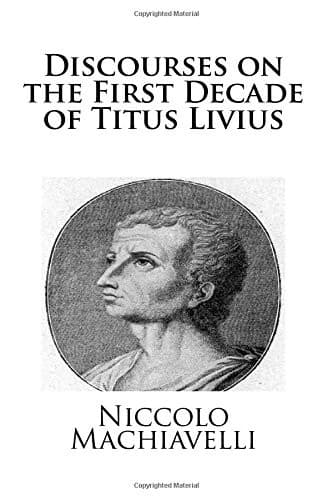
Discourses on the First Decade of Titus LiviusMachiavelli, Niccolò
Philosophy
Discourses on the First Decade of Titus Livius
Machiavelli, Niccolò
Livy. Ab urbe condita; Political science -- Early works to 1800; Rome -- Historiography
But to pass from these solitary attempts to those in which several are
engaged, I affirm it to be shown by history that all such plots have
been contrived by men of great station, or by those who have been on
terms of close intimacy with the prince, since no others, not being
downright madmen, would ever think of conspiring. For men of humble
rank, and such as are not the intimates of their prince, are neither
fed by the hopes nor possessed of the opportunities essential for such
attempts. Because, in the first place, men of low degree will never
find any to keep faith with them, none being moved to join in their
schemes by those expectations which encourage men to run great risks;
wherefore, so soon as their design has been imparted to two or three,
they are betrayed and ruined. Or, assuming them fortunate enough to
have no traitor of their number, they will be so hampered in the
execution of their plot by the want of easy access to the prince, that
they are sure to perish in the mere attempt. For if even men of great
position, who have ready access to the prince, succumb to the
difficulties which I shall presently notice, those difficulties must be
infinitely increased in the case of men who are without these
advantages. And because when life and property are at stake men are not
utterly reckless, on perceiving themselves to be weak they grow
cautious, and though cursing the tyrant in their hearts, are content to
endure him, and to wait until some one of higher station than they,
comes forward to redress their wrongs. So that should we ever find
these weaklings attempting anything, we may commend their courage
rather than their prudence.
We see, however, that the great majority of conspirators have been
persons of position and the familiars of their prince, and that their
plots have been as often the consequence of excessive indulgence as of
excessive injury; as when Perennius conspired against Commodus,
Plautianus against Severus, and Sejanus against Tiberius; all of whom
had been raised by their masters to such wealth, honours, and
dignities, that nothing seemed wanting to their authority save the
imperial name. That they might not lack this also, they fell to
conspiring against their prince; but in every instance their
conspiracies had the end which their ingratitude deserved.
Public-domain text, read in full here on John Shaqi.
Reviews
Reviews
No reviews yet
Be the first to share your thoughts on this work.
Elsewhere in the archive
Join the Discussion
Join the discussion
Sign in to leave a comment or review.
Sign InorCreate an account