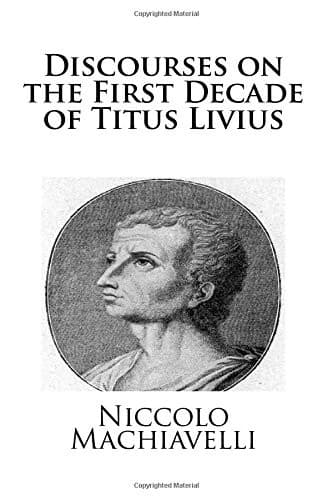
Discourses on the First Decade of Titus LiviusMachiavelli, Niccolò
Philosophy
Discourses on the First Decade of Titus Livius
Machiavelli, Niccolò
Livy. Ab urbe condita; Political science -- Early works to 1800; Rome -- Historiography
Courage fails a conspirator either from his own poorness of spirit, or
from his being overcome by some feeling of reverence. For such majesty
and awe attend the person of a prince, that it may well happen that he
softens or dismays his executioners. When Caius Marius was taken by the
people of Minturnum, the slave sent in to slay him, overawed by the
bearing of the man, and by the memories which his name called up,
became unnerved, and powerless to perform his office. And if this
influence was exercised by one who was a prisoner, and in chains, and
overwhelmed by adverse fortune, how much more must reverence be
inspired by a prince who is free and uncontrolled, surrounded by his
retinue and by all the pomp and splendour of his station; whose dignity
confounds, and whose graciousness conciliates.
Certain persons conspiring against Sitalces, king of Thrace, fixed a
day for his murder, and assembled at the place appointed, whither the
king had already come. Yet none of them raised a hand to harm him, and
all departed without attempting anything against him or knowing why
they refrained; each blaming the others. And more than once the same
folly was repeated, until the plot getting wind, they were taken and
punished for what they might have done, yet durst not do.
Two brothers of Alfonso, Duke of Ferrara, conspired against him,
employing as their tool a certain priest named Giennes, a singing-man
in the service of the Duke. He, at their request, repeatedly brought
the Duke into their company, so that they had full opportunity to make
away with him. Yet neither of them ever ventured to strike the blow;
till at last, their scheme being discovered, they paid the penalty of
their combined cowardice and temerity. Such irresolution can only have
arisen from their being overawed by the majesty of the prince, or
touched by his graciousness.
Public-domain text, read in full here on John Shaqi.
Reviews
Reviews
No reviews yet
Be the first to share your thoughts on this work.
Elsewhere in the archive
Join the Discussion
Join the discussion
Sign in to leave a comment or review.
Sign InorCreate an account