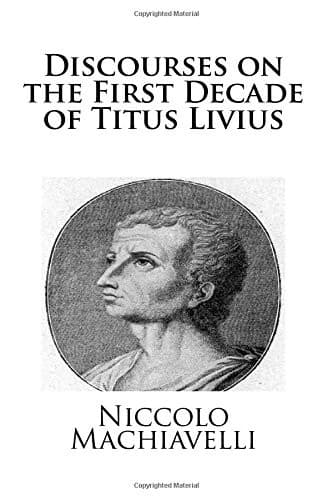
Discourses on the First Decade of Titus LiviusMachiavelli, Niccolò
Philosophy
Discourses on the First Decade of Titus Livius
Machiavelli, Niccolò
Livy. Ab urbe condita; Political science -- Early works to 1800; Rome -- Historiography
chosen to conduct the siege of Pisa, Antonio was left out; and though
it cannot with certainty be shown that any harm resulted to our
republic from his not having been sent on this enterprise, we may
reasonably conjecture that such was indeed the case. For as the people
of Pisa were then without means either for subsistence or defence, it
may be believed that had Antonio been there he would have reduced them
to such extremities as would have forced them to surrender at
discretion to the Florentines. But Pisa being besieged by captains who
knew neither how to blockade nor how to storm it, held out so long,
that the Florentines, who should have reduced it by force, were obliged
to buy its submission. Neglect like this might well move Antonio to
resentment; and he must needs have been both very patient and very
forgiving if he felt no desire to revenge himself when he could, by the
ruin of the city or by injuries to individual citizens. But a republic
should beware not to rouse such feelings, as I shall show in the
following Chapter.
CHAPTER XVII.—_That we are not to offend a Man, and then send him to
fill an important Office or Command._
A republic should think twice before appointing to an important command
a citizen who has sustained notable wrong at the hands of his
fellow-citizens. Claudius Nero, quitting the army with which he was
opposing Hannibal, went with a part of his forces into the March of
Ancona, designing to join the other consul there, and after joining him
to attack Hasdrubal before he came up with his brother. Now Claudius
had previously commanded against Hasdrubal in Spain, and after driving
him with his army into such a position that it seemed he must either
fight at a disadvantage or perish by famine, had been outwitted by his
adversary, who, while diverting his attention with proposals of terms,
contrived to slip through his hands and rob him of the opportunity for
effecting his destruction. This becoming known in Rome brought Claudius
into so much discredit both with the senate and people, that to his
great mortification and displeasure, he was slightingly spoken of by
the whole city. But being afterwards made consul and sent to oppose
Hannibal, he took the course mentioned above, which was in itself so
hazardous that all Rome was filled with doubt and anxiety until tidings
came of Hasdrubal’s defeat. When subsequently asked why he had played
so dangerous a game, wherein without urgent necessity he had staked the
very existence of Rome, Claudius answered, he had done so because he
knew that were he to succeed he would recover whatever credit he had
lost in Spain; while if he failed, and his attempt had an untoward
issue, he would be revenged on that city and On those citizens who had
so ungratefully and indiscreetly wronged him.
Public-domain text, read in full here on John Shaqi.
Reviews
Reviews
No reviews yet
Be the first to share your thoughts on this work.
Elsewhere in the archive
Join the Discussion
Join the discussion
Sign in to leave a comment or review.
Sign InorCreate an account