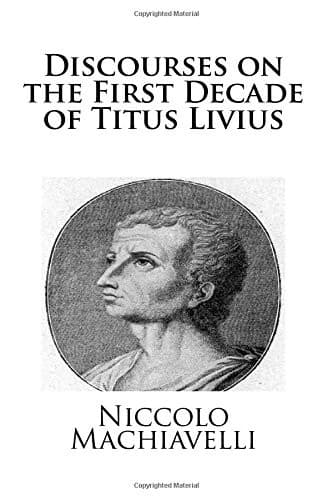
Discourses on the First Decade of Titus LiviusMachiavelli, Niccolò
Philosophy
Discourses on the First Decade of Titus Livius
Machiavelli, Niccolò
Livy. Ab urbe condita; Political science -- Early works to 1800; Rome -- Historiography
his allies, rose against him, for no other reason than that they stood
in no fear of him. For men are so restless, that if ever so small a
door be opened to their ambition, they forthwith forget all the love
they have borne their prince in return for his graciousness and
goodness, as did these soldiers and allies of Scipio; when, to correct
the mischief, he was forced to use something of a cruelty foreign to
his nature.
As to Hannibal, we cannot point to any particular instance wherein his
cruelty or want of faith are seen to have been directly hurtful to him;
but we may well believe that Naples and other towns which remained
loyal to the Roman people, did so by reason of the dread which his
character inspired. This, however, is abundantly clear, that his
inhumanity made him more detested by the Romans than any other enemy
they ever had; so that while to Pyrrhus, in Italy with his army, they
gave up the traitor who offered to poison him, Hannibal, even when
disarmed and a fugitive, they never forgave, until they had compassed
his death.
To Hannibal, therefore, from his being accounted impious, perfidious,
and cruel, these disadvantages resulted; but, on the other hand, there
accrued to him one great gain, noticed with admiration by all
historians, namely, that in his army, although made up of men of every
race and country, no dissensions ever broke out among the soldiers
themselves, nor any mutiny against their leader. This we can only
ascribe to the awe which his character inspired, which together with
the great name his valour had won for him, had the effect of keeping
his soldiers quiet and united. I repeat, therefore, that it is of
little moment which method a captain may follow if he be endowed with
such valour as will bear him out in the course which he adopts. For, as
I have said, there are disadvantages incident to both methods unless
corrected by extraordinary valour.
And now, since I have spoken of Scipio and Hannibal, the former of whom
by praiseworthy, the latter by odious qualities, effected the same
results, I must not, I think, omit to notice the characters of two
Roman citizens, who by different, yet both by honourable methods,
obtained a like glory.
Chapter XXII.—_That the severity of Manlius Torquatus and the
gentleness of Valerius Corvinus won for both the same Glory._
Public-domain text, read in full here on John Shaqi.
Reviews
Reviews
No reviews yet
Be the first to share your thoughts on this work.
Elsewhere in the archive
Join the Discussion
Join the discussion
Sign in to leave a comment or review.
Sign InorCreate an account