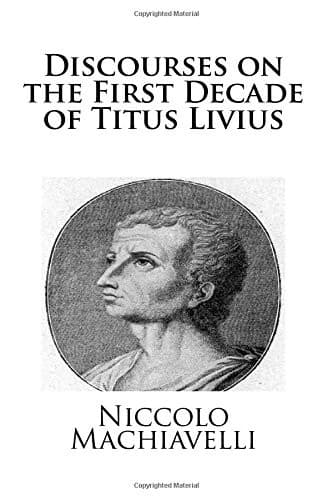
Discourses on the First Decade of Titus LiviusMachiavelli, Niccolò
Philosophy
Discourses on the First Decade of Titus Livius
Machiavelli, Niccolò
Livy. Ab urbe condita; Political science -- Early works to 1800; Rome -- Historiography
A well-governed republic, therefore, ought, as I have said, to throw
wide the door to all who seek public favour by open courses, and to
close it against any who would ingratiate themselves by underhand
means. And this we find was done in Rome. For the Roman republic, as a
reward to any citizen who served it well, ordained triumphs and all the
other honours which it had to bestow; while against those who sought to
aggrandize themselves by secret intrigues, it ordained accusations and
impeachment; and when, from the people being blinded by a false show of
benevolence, these proved insufficient, it provided for a dictator, who
with regal authority might bring to bounds any who had strayed beyond
them, as instanced in the case of Spurius Melius. And if conduct like
his be ever suffered to pass unchastised, it may well be the ruin of a
republic, for men when they have such examples set them are not easily
led back into the right path.
CHAPTER XXIX.—_That the Faults of a People are due to its Prince._
Let no prince complain of the faults committed by a people under his
control; since these must be ascribed either to his negligence, or to
his being himself blemished by similar defects. And were any one to
consider what peoples in our own times have been most given to robbery
and other like offences, he would find that they have only copied their
rulers, who have themselves been of a like nature. Romagna, before
those lords who ruled it were driven out by Pope Alexander VI., was a
nursery of all the worst crimes, the slightest occasion giving rise to
wholesale rapine and murder. This resulted from the wickedness of these
lords, and not, as they asserted, from the evil disposition of their
subjects. For these princes being poor, yet choosing to live as though
they were rich, were forced to resort to cruelties innumerable and
practised in divers ways; and among other shameful devices contrived by
them to extort money, they would pass laws prohibiting certain acts,
and then be the first to give occasion for breaking them; nor would
they chastise offenders until they saw many involved in the same
offence; when they fell to punishing, not from any zeal for the laws
which they had made, but out of greed to realize the penalty. Whence
flowed many mischiefs, and more particularly this, that the people
being impoverished, but not corrected, sought to make good their
injuries at the expense of others weaker than themselves. And thus
there sprang up all those evils spoken of above, whereof the prince is
the true cause.
Public-domain text, read in full here on John Shaqi.
Reviews
Reviews
No reviews yet
Be the first to share your thoughts on this work.
Elsewhere in the archive
Join the Discussion
Join the discussion
Sign in to leave a comment or review.
Sign InorCreate an account