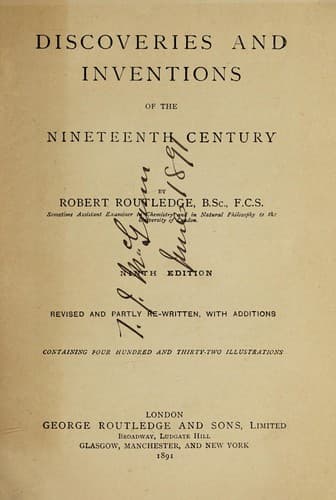
Discoveries and Inventions of the Nineteenth CenturyRoutledge, Robert
History
Discoveries and Inventions of the Nineteenth Century
Routledge, Robert
Inventions -- History -- 19th century
The wheel at Earl’s Court exceeds the Ferris wheel in diameter by 50
feet, being 300 feet across. It is supported on two towers, 175 feet
high, each formed by four columns 4 feet square, built of steel plates
with internal diaphragms, and surmounted by balconies that may be
ascended in elevators raised by a weight of water, which, after having
been discharged into a reservoir under the ground level, is again pumped
up to the top of the towers. Between the balconies on each tower there
is also a communication _through the axle_ of the wheel, which, instead
of being solid as at Chicago, is a tube of 7 feet diameter, and 35 feet
long, made in sections, riveted together, of steel 1 inch thick, and
weighing no less than 58 tons. The raising and fixing in its high place
of such a mass of metal required specially ingenious devices, which have
been greatly appreciated by professional engineers. But for these
devices, the erection of scaffolding in the ordinary way of proceeding
would have entailed an outlay simply enormous. The axle is stiffened by
projecting rings, and, between pairs of these, the spoke rods are
attached by pins 3 inches in diameter. The axle was the production of
Messrs. Maudslay, Field & Co.; all the rest of the metal work was made
at the Arrol Works at Glasgow, and the carriages were constructed by
Brown, Marshall & Co., of Birmingham. The Earl’s Court wheel is turned
by a mechanism different from that of the Chicago wheel, for whereas the
latter was provided with cogs, the former has two chains, each 1,000
feet long and 8 tons weight, surrounding the periphery of the wheel on
either side. The chains go over drums in the engine-shed, from which
they pass underground to guide-pulleys, and as they unwind from the
Great Wheel, they again go over guide-pulleys to lead them back to the
drums. These chains are firmly held throughout in the jaws of V-shaped
grooves, and there are arrangements for taking up the slack. The drums
are actuated by wheel gearing, connected with two horizontal Robey steam
engines, each of 50 horse-power, one on either side, capable of being
worked singly or together. It is, however, found sufficient to use the
engine of one side only, and even then to work it at but 16 horse-power,
and the operation can be controlled by one man, who has also the command
of a brake. Both starting and stopping are accomplished with the
greatest smoothness and absence of strain or jar. There are forty
carriages, each 25 feet long, 9 feet wide, and 10 feet high. Each will
accommodate forty passengers, and these enter at the ends from eight
platforms at different heights from the ground, so arranged as to be on
the level of the eight lowest carriages while the wheel is stationary.
The passengers who have had their ride leave at the other end of the
carriages by eight similar platforms on the other side of the wheel.
After the change of passengers in one set of eight carriages, the wheel
Public-domain text, read in full here on John Shaqi.
Reviews
Reviews
No reviews yet
Be the first to share your thoughts on this work.
Elsewhere in the archive
Join the Discussion
Join the discussion
Sign in to leave a comment or review.
Sign InorCreate an account