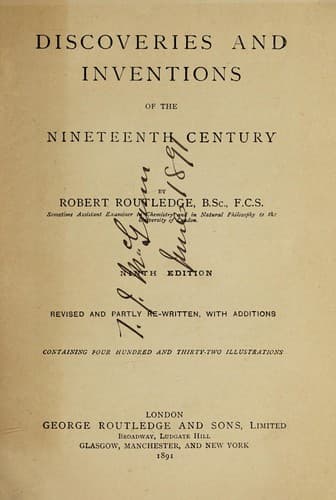
Discoveries and Inventions of the Nineteenth CenturyRoutledge, Robert
History
Discoveries and Inventions of the Nineteenth Century
Routledge, Robert
Inventions -- History -- 19th century
Of the immense variety of tools and mechanical contrivances employed in
modern times, by far the greatest number are designed to impart to
certain materials some definite shape. The brickmaker’s mould, the
joiner’s plane, the stonemason’s chisel, the potter’s wheel, are
examples of simple tools. More elaborate are the coining press, the
machine for planing iron, the drilling machine, the turning lathe, the
rolling mill, the Jacquard loom. But all such tools and machines have
one principle in common—a principle which casual observers may easily
overlook, but one which is of the highest importance, as its application
constitutes the very essence of the modern process of _manufacture_ as
distinguished from the slow and laborious mode of making things by hand.
The principle will be easily understood by a single example. Let it be
required to draw straight lines across a sheet of paper. Few persons can
take a pen or pencil, and do this with even an approach to accuracy, and
at best they can do it but slowly and imperfectly. But with the aid of a
ruler any number of straight lines may be drawn rapidly and surely. The
former case is an instance of _making_ by hand, the latter represents
_manufacturing_, the ruler being the tool or machine. Let it be observed
that the ruler has in itself the kind of form required—that is to say,
straightness—and that in using it we copy or transfer this straightness
to the mark made on the paper. This is a simple example of the _copying
principle_, which is so widely applied in machines for manufacturing;
for, in all of these, materials are shaped or moulded by various
contrivances, so as to reproduce certain definite forms, which are in
some way contained within the machine itself. This will be distinctly
seen in the tools which are about to be described.
[Illustration:
FIG. 28.—_Whitworth’s Screw Dies and Tap._
]
Public-domain text, read in full here on John Shaqi.
Reviews
Reviews
No reviews yet
Be the first to share your thoughts on this work.
Elsewhere in the archive
Join the Discussion
Join the discussion
Sign in to leave a comment or review.
Sign InorCreate an account