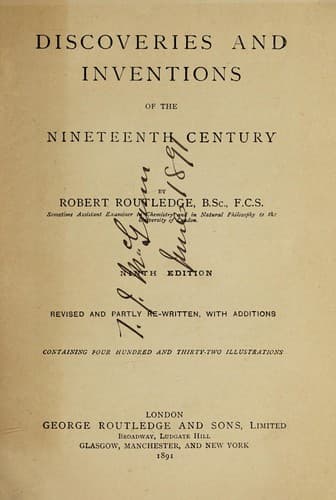
Discoveries and Inventions of the Nineteenth CenturyRoutledge, Robert
History
Discoveries and Inventions of the Nineteenth Century
Routledge, Robert
Inventions -- History -- 19th century
The method of forming screws by dies and taps is, however, applicable
only to those of small dimensions, and even for these it is not employed
where great accuracy is required. Perfect screws can only be cut with a
lathe, such as that represented in Fig. 29. In this we must first call
the reader’s attention to the portion of the apparatus marked A, which
receives the name of the _slide-rest_. The invention of this contrivance
by Maudsley had the effect of almost revolutionizing mechanical art, for
by its aid it became possible to _produce true surfaces in the lathe_.
Before the slide-rest was introduced, the instrument which cut the wood
or metal was held in the workman’s hand, and whatever might be his skill
and strength, the steadiness and precision thus obtainable were far
inferior to those which could be reached by the grip of an iron hand,
guided by unswerving bars. The slide-rest was contrived by Maudsley in
the first instance for cutting screws, but its principle has been
applied for other purposes. This principle consists in attaching the
cutting tool to a slide which is incapable of any motion, except in the
one direction required. Thus the slide, A, represented in Fig. 29, moves
along the _bed_ of the lathe, B, carrying the cutter with perfect
steadiness in a straight line parallel to the axis of the lathe. There
are also two other slides for adjusting the position of the cutter; the
handle, _a_, turns a screw, which imparts a transverse motion to the
piece, _b_, and the tool receives another longitudinal movement from the
handle, _c_. The pieces are so arranged that these movements take place
in straight lines in precisely the required direction, and without
permitting the tool to be unsteady, or capable of any rocking motion. In
Whitworth’s lathe, between the two sides of the bed, and therefore not
visible in the figure, is a shaft placed perfectly parallel to the axis
of the lathe. One end of this shaft is seen carrying the wheel, C, which
is connected with a train of wheels, D, and is thus made to revolve at a
speed which can be made to bear any required proportion to that of the
mandril, E, of the lathe, by properly arranging the numbers of the teeth
in the wheels; and the machine is provided with several sets of wheels,
which can be substituted for each other. The greater part of the length
of this shaft is formed with great care into an exceedingly accurate
screw, which works in a nut forming part of the slide-rest. The effect,
therefore, of the rotation of the screw is to cause the slide-rest to
travel along the bed of the lathe, advancing with each revolution of the
screw through a space equal to its pitch distance. There is an
arrangement for releasing the nut from the guiding-screw, by moving a
lever, and then by turning the winch the slide-rest is moved along by a
wheel engaging the teeth of a rack at the back of the lathe. Now, if the
train of wheels, C D, be so arranged that the screw makes one revolution
Public-domain text, read in full here on John Shaqi.
Reviews
Reviews
No reviews yet
Be the first to share your thoughts on this work.
Elsewhere in the archive
Join the Discussion
Join the discussion
Sign in to leave a comment or review.
Sign InorCreate an account