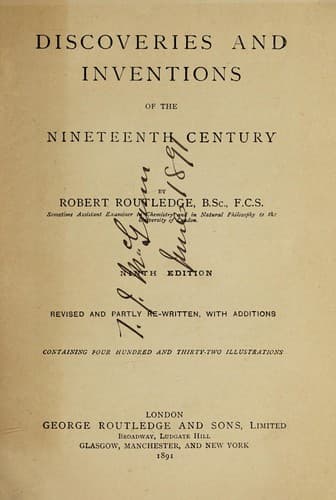
Discoveries and Inventions of the Nineteenth CenturyRoutledge, Robert
History
Discoveries and Inventions of the Nineteenth Century
Routledge, Robert
Inventions -- History -- 19th century
The movable headstock, when it has
been moved into the position required, is firmly clamped by a
thumbscrew. The face of the bed is graduated into inches and their
subdivisions. Here it should be explained that the machine is not
intended to be used for ascertaining the absolute dimensions of objects,
but for showing by what fraction of an inch the size of the work
measured differs from a certain standard piece. Each headstock carries a
screw of 1/20 inch pitch, made with the greatest possible care and
accuracy. To the head of the screw in the movable headstock is attached
the wheel, _b_, having its circumference divided into 250 equal parts,
and a fixed index, _c_, from which its graduations may be counted. An
exactly similar arrangement is presented in connection with the screw
turning in the fixed headstock, but the wheel is much larger, and its
circumference is divided in 500 equal parts. It follows, therefore, that
if the large wheel be turned so that one division passes the index, the
bar moves in a straight line 1/500 of the 1/20 of an inch, that is,
1/10000 an inch. The ends of the bars, _d_ and _e_, are formed with
perfectly plane and parallel surfaces, and an ingenious method is
adopted of securing equality of pressure when comparisons are made. A
plate of steel, with perfectly parallel faces, called a _gravity-piece_,
or _feeler_, is placed between the flat end of the bar and the
standard-piece, and the pressure when the screw-reading is taken must be
just sufficient to prevent this piece of steel from slipping down, and
that is the case when the steel remains suspended and can nevertheless
be easily made to slide about by a touch of the finger. Thus any piece
which, with the same screw-readings, sustains the gravity-piece in the
same manner as the standard, will be of exactly the same length; or the
number of divisions through which the large wheel must be turned to
enable it to do so tells the difference of the dimensions in
ten-thousandth parts of an inch. By this instrument, therefore, gauges,
patterns, &c., can be verified with the greatest precision, and pieces
can be reproduced perfectly agreeing in their dimensions with a standard
piece. Thus, for example, the diameters of shafting can be brought with
the greatest precision to the exact size required to best fit their
bearings.
Public-domain text, read in full here on John Shaqi.
Reviews
Reviews
No reviews yet
Be the first to share your thoughts on this work.
Elsewhere in the archive
Join the Discussion
Join the discussion
Sign in to leave a comment or review.
Sign InorCreate an account