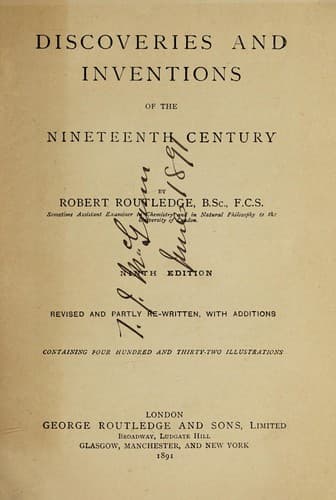
Discoveries and Inventions of the Nineteenth CenturyRoutledge, Robert
History
Discoveries and Inventions of the Nineteenth Century
Routledge, Robert
Inventions -- History -- 19th century
The whole arrangement is self-acting, so that when once the pattern and
the rough block of wood have been fixed in their positions, the machine
completes the work, and produces an exact repetition of the shape of the
pattern. It is plain that any kind of forms can be easily cut by this
lathe, the only condition being that the surface of the pattern must not
present any re-entering portions which the edge of the guide-wheel
cannot follow. The machine is largely used for the purposes named above,
and also for the manufacture of the spokes of carriage-wheels. The
limits of this article will not permit of a description of the beautiful
adjustments given to the mechanism in the example before us,
particularly in the arrangement for driving the cutters in a framework
combining lateral and longitudinal motions; but the intelligent reader
may gather some hints of these by a careful inspection of the figure.
The machine is sometimes made with the frame carrying the guide-wheel
and cutters, not rocking but sliding in a direction transverse to the
axes of the headstocks. It is extremely interesting to see the Blanchard
lathe at work, and observe how perfectly and rapidly the curves and form
of the patterns seem to grow, as it were, out of the rudely-shaped piece
of wood, which, of course, contains a large excess of material, or, in
the picturesque and expressive phrase of the workmen, _always gives the
machine something to eat_.
[Illustration:
FIG. 36.—_Vertical Saw._
]
_SAWING MACHINES._
Public-domain text, read in full here on John Shaqi.
Reviews
Reviews
No reviews yet
Be the first to share your thoughts on this work.
Elsewhere in the archive
Join the Discussion
Join the discussion
Sign in to leave a comment or review.
Sign InorCreate an account