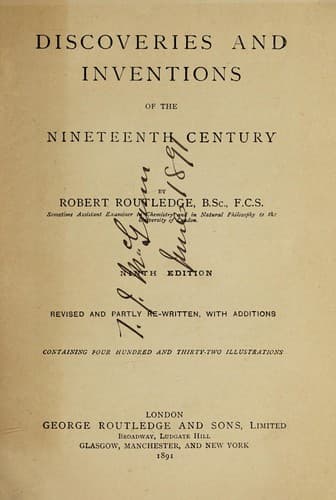
Discoveries and Inventions of the Nineteenth CenturyRoutledge, Robert
History
Discoveries and Inventions of the Nineteenth Century
Routledge, Robert
Inventions -- History -- 19th century
When the traffic in the streets of London became so great that the
ordinary thoroughfares were unable to meet public requirements, the bold
project was conceived of making a railway under the streets. The
construction of a line of railway beneath the streets of a populous
city, amidst a labyrinth of gas-pipes, water-mains, sewers, &c., is
obviously an undertaking presenting features so remarkable that the
London Underground Railway cannot here be passed over without a short
notice. Its construction occupied about three years, and it was opened
for traffic in 1863. The line commencing at Paddington, and passing
beneath Edgware Road at right angles, reaches Marylebone Road, under the
centre of which it proceeds, and passing beneath the houses at one end
of Park Crescent, Portland Place, it follows the centre of Euston Road
to King’s Cross, where connection with the Great Northern and Midland
system is effected. Here the line bends sharply southwards, and proceeds
to Farringdon Street Station, the original terminus. A subsequent
extension takes an easterly direction and reaches Aldgate Station, the
nominal terminus. The crown of the arch which covers the line is in some
places only a few inches beneath the level of the streets; in other
places it is several feet below the surface, and, in fact, beneath the
foundations of the houses and other buildings. The steepest gradient on
the line is 1 in 100, and the sharpest curve has a radius of 200 yards.
The line is nearly all curved, there not being in all its length
three-quarters of a mile of straight rails. The difficulties besetting
an undertaking of this kind would be tedious to describe, but may
readily be imagined. The line traverses every kind of soil—clay, gravel,
sand, rubbish, all loosened by previous excavations for drains, pipes,
foundations, &c.; and the arrangements of these drains, water and
gas-pipes, had to be reconciled with the progress of the railway works,
without their uses being interfered with even for a time. Of the
stations the majority have roofs of the ordinary kind, open to the sky;
but two of them, namely, Baker Street and Gower Street, are completely
underground stations, and their roofs are formed by the arches of
brickwork immediately below the streets. The arrangements at these
stations show great boldness and inventiveness of design. The booking
offices for the up line are on one side of the road, and those for the
down line on the other. Fig. 50 represents the interior of the Gower
Street Station, and the other is very similar. In each the platforms are
325 ft. long and 10 ft. broad, and the stations are lighted by lateral
openings through the springing of the arch which forms the roof. This
arch is a portion of a circle of 32 ft. radius, with a span of 45 ft.
and a rise of 9 ft. at the crown. The lateral openings are arched at the
top and bottom, but the sides are flat. The width of each is 4 ft. 9
in., and the height outside 6 ft., increasing to 10 ft. at the ends
Public-domain text, read in full here on John Shaqi.
Reviews
Reviews
No reviews yet
Be the first to share your thoughts on this work.
Elsewhere in the archive
Join the Discussion
Join the discussion
Sign in to leave a comment or review.
Sign InorCreate an account