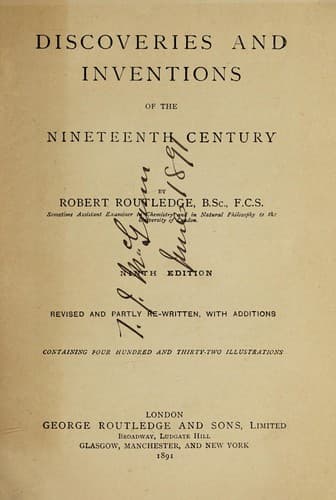
Discoveries and Inventions of the Nineteenth CenturyRoutledge, Robert
History
Discoveries and Inventions of the Nineteenth Century
Routledge, Robert
Inventions -- History -- 19th century
The portion of the line which unites Sacramento to Ogden, 743 miles, was
commenced in 1863 and finished in 1869, but nearly half of the entire
length was constructed in 1868, and about 50 miles west of Ogden, the
remarkable engineering feat of laying 10 miles of railway in one day was
performed. It was thus accomplished: when the waggon loaded with the
rails arrived at the end of the track, the two outer rails were seized,
hauled forward off the car, and laid upon the sleepers by four men, who
attended to this duty only. The waggon was pushed forwards over these
rails, and the process of putting down the rails was repeated, while
behind the waggon came a little army of men, who drove in the spikes and
screwed on the fish-plates, and, lastly, a large number of Chinese
workmen, with pickaxes and spades, who ballasted the line. The average
rate at which these operations proceeded was about 240 ft. of track in
77½ seconds, and in these 10 miles of railway there were 2,585,000
cross-ties, 3,520 iron rails, 55,000 spikes, 7,040 fish-plates, and
14,080 bolts with screws, the whole weighing 4,362,000 lbs.! Four
thousand men and hundreds of waggons were required, but in the 10 miles
all the rails were laid by the same eight men, each of whom is said to
have that day walked 10 miles and lifted 1,000 tons of iron rails.
Nothing but the practice acquired during the four previous years and the
most excellent arrangement and discipline could have made the
performance of such a feat possible as the laying of eight miles of the
track in six hours, which was the victory achieved by these stalwart
navvies before dinner.
The line crosses the great American desert, distinguished for its
desolate aspect and barren soil, and so thickly strewn with alkaline
dust that it appears almost like a snow-covered plain. The alkali is
caustic, and where it abounds no vegetation can exist, most of the
surface of this waste being fine, hard grey sand, mixed with the
fragments of marine shells and beds of alkali.
Public-domain text, read in full here on John Shaqi.
Reviews
Reviews
No reviews yet
Be the first to share your thoughts on this work.
Elsewhere in the archive
Join the Discussion
Join the discussion
Sign in to leave a comment or review.
Sign InorCreate an account