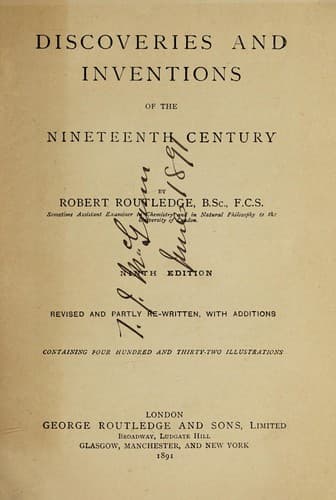
Discoveries and Inventions of the Nineteenth CenturyRoutledge, Robert
History
Discoveries and Inventions of the Nineteenth Century
Routledge, Robert
Inventions -- History -- 19th century
These lines of railway, connecting Omaha with Sacramento, are remarkable
evidences of the energy and spirit which characterize the Anglo-Saxon
race in America. The men who conceived the design of the Central Pacific
Railroad, and actually carried it into effect, were not persons
experienced in railway construction; but five middle-aged traders of
Sacramento, two of whom where drapers, one a wholesale grocer, and the
others ironmongers, believing that such a railway should be made, and
finding no one ready to undertake it, united together, projected the
railway, got it completed, and now manage it. These gentlemen were
associated with an engineer named Judah, who was a sanguine advocate of
the scheme, and made the preliminary surveys, if he did not plan the
line. The line is considered one of the best appointed and best managed
in the States; yet the project was at first ridiculed and pronounced
impracticable by engineers of high repute, opposed by capitalists, and
denounced by politicians. An eminent banker, who personally regarded the
scheme with hopefulness, would not venture, however, to take any stock,
lest the credit of his bank should be shaken, were he known to be
connected with so wild a scheme. And, indeed, the difficulties appeared
great. Except wood, all the materials required, the iron rails, the
pickaxes and spades, the waggons, the locomotives, and the machinery had
to be sent by sea from New York, round Cape Horn, a long and perilous
voyage of nine months duration, and transhipped at San Francisco for
another voyage of 120 miles before they could reach Sacramento. Add to
this that workmen were so scarce in California, and wages so high, that
to carry on the work it was necessary to obtain men from New York; and
during its progress 10,000 Chinamen were brought across the Pacific, to
work as labourers. Subscriptions came in very slowly, and before 30
miles of the line had been constructed, the price of iron rose in a very
short time to nearly three times its former amount. At this critical
juncture, the five merchants decided to defray, out of their own private
fortunes, the cost of keeping 800 men at work on the line for a whole
year. We cannot but admire the unswerving confidence in their enterprise
displayed by these five country merchants, unskilled in railway making,
unaided by public support, and even discouraged in their project by
their own friends. The financial and legal obstacles they successfully
surmounted were not the only difficulties to be overcome. They had the
engineering difficulties of carrying their line over the steep Sierra, a
work of four years; long tunnels had to be bored; one spring when snow
60 ft. in depth covered the track, it had to be removed by the shovel
for 7 miles along the road; saw-mills had to be erected in the
mountains, to prepare the sleepers and other timber work; wood and water
had to be carried 40 miles across alkali plains, and locomotives and
Public-domain text, read in full here on John Shaqi.
Reviews
Reviews
No reviews yet
Be the first to share your thoughts on this work.
Elsewhere in the archive
Join the Discussion
Join the discussion
Sign in to leave a comment or review.
Sign InorCreate an account