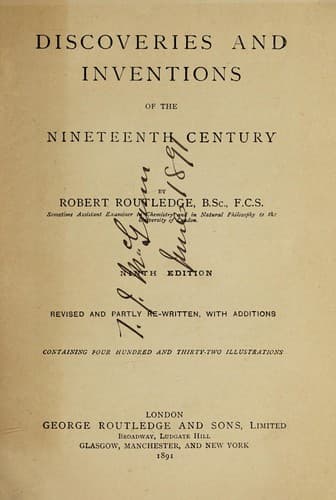
Discoveries and Inventions of the Nineteenth CenturyRoutledge, Robert
History
Discoveries and Inventions of the Nineteenth Century
Routledge, Robert
Inventions -- History -- 19th century
The construction of railways over lofty ranges of mountains will be
found illustrated by the brief notices in other pages of the Union
Pacific line in the United States, and of the St. Gothard railway over
the Alps. In such cases, the track has been to a great extent carried
over the spurs or along the sides of the mountains, so that such
inclines might be obtained as the ordinary locomotive was capable of
ascending. The expensive operation of tunnelling was resorted to only
where sinuous deviations from the more direct route involved a still
greater expenditure of initial cost, or a continual waste of time and
energy in the actual working of the line. Sometimes winding tracks,
almost returning by snake-like loops on their own route, as projected on
the map, were required in order that the ascent could be made with an
incline practicable for the ordinary locomotive. In the earlier
development of railways, there were to be met with cable inclines, where
the traction of the locomotive had to be superseded or supplemented by
that of a rope or chain wound round a drum actuated by a stationary
steam-engine. The more powerful locomotives of the present day are able
to mount grades of such inclination that the employment of cable
traction is no longer requisite, except in but a few cases. Railways had
carried passengers about in all parts of the world for many years before
the engineer addressed himself to the problem of easily and quickly
taking people up heights of steep and toilsome ascent, sought generally
for the sake of the prospect, etc. Such, at least, has been the object
of most of the inclined railways already constructed, but to this their
utility is by no means limited, and as their safety and stability has
been proved by many years of use, they may find wider applications than
the gratification of the tourist and pleasure-seeker.
Public-domain text, read in full here on John Shaqi.
Reviews
Reviews
No reviews yet
Be the first to share your thoughts on this work.
Elsewhere in the archive
Join the Discussion
Join the discussion
Sign in to leave a comment or review.
Sign InorCreate an account