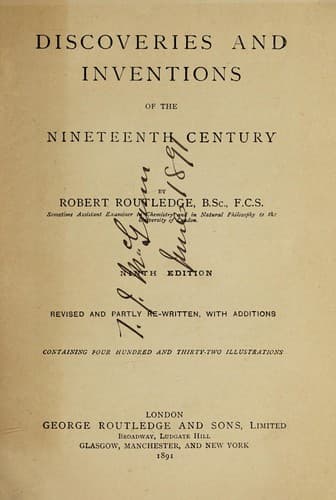
Discoveries and Inventions of the Nineteenth CenturyRoutledge, Robert
History
Discoveries and Inventions of the Nineteenth Century
Routledge, Robert
Inventions -- History -- 19th century
A great impulse was given to steam navigation, by the substitution of
iron for wood in the construction of ships. The weight of an iron ship
is only two-thirds that of a wooden ship of the same size. It must be
remembered that, though iron is many times heavier than wood, bulk for
bulk, the required strength is obtained by a much less quantity of the
former. A young reader might, perhaps, think that a wooden ship must
float better than an iron one; but the law of floating bodies is, that
the part of the floating body which is below the level of the water,
takes up the space of exactly so much water as would have the same
weight as the floating body, or in fewer words, a floating body
displaces its own _weight_ of water. Thus we see that an iron ship,
being lighter than a wooden one, must have more buoyancy. The use of
iron in ship-building was strenuously advocated by the late Sir W.
Fairbairn, and his practical knowledge of the material gave great
authority to his opinion. He pointed out that the strains to which ships
are exposed are of such a nature, that vessels should be made on much
the same principles as the built-up iron beams or girders of railway
bridges. How successfully these principles have been applied will be
noticed in the case of the _Great Eastern_. This ship, by far the
largest vessel ever built, was designed by Mr. Brunel, and was intended
to carry mails and passengers to India by the long sea route. The
expectations of the promoters were disappointed in regard to the speed
of the vessel, which did not exceed 15 miles an hour; and no sooner had
she gone to sea than she met with a series of accidents, which appear,
for a time, to have destroyed public confidence in the vessel as a
sea-going passenger ship. Some damage and much consternation were
produced on board by the explosion of a steam jacket a few days after
the launch. Then the huge ship encountered a strong gale in Holyhead
Harbour, and afterwards was disabled by a hurricane in the Atlantic, in
which her rudder and paddles were so damaged, that she rolled about for
several days at the mercy of the waves. At New York she ran upon a rock,
and the outer iron plates were stripped off the bottom of the ship for a
length of 80 ft. She was repaired and came home safely; but the
companies which owned her found themselves in financial difficulties,
and the big ship, which had cost half a million sterling, was sold for
only £25,000, or only about one-third of her value as old materials.
Public-domain text, read in full here on John Shaqi.
Reviews
Reviews
No reviews yet
Be the first to share your thoughts on this work.
Elsewhere in the archive
Join the Discussion
Join the discussion
Sign in to leave a comment or review.
Sign InorCreate an account