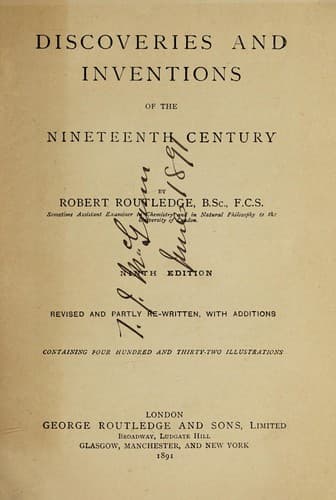
Discoveries and Inventions of the Nineteenth CenturyRoutledge, Robert
History
Discoveries and Inventions of the Nineteenth Century
Routledge, Robert
Inventions -- History -- 19th century
semicircle, and let the circumference between the point where the last
line cuts it and the point o be divided into ninety equal parts, and let
these parts be numbered, and straight lines drawn from the centre to
each point of division. In the figure the lines are drawn at every fifth
division, and the centre line of the ship coincides with that drawn
through the forty-fifth division. In this case the vessel is said to be
inclined, or heeled, at an angle of forty-five degrees, which is usually
written 45°. In a position half-way between this and the upright the
angle of heel would be 22½°, and so on. The reader no doubt perceives
that a ship, like any other body, must be supported, and he is probably
aware that the support is afforded by the upward pressure of the water.
He may also be familiar with the fact that the weight of every body acts
upon it as if the whole weight were concentrated at one certain point,
and that this point is called the centre of gravity of the body.
Whatever may be the position of the body itself, its centre of gravity
remains always at the same point with reference to the body. When the
centre of gravity happens to be within the solid substance of a body,
there is no difficulty in thinking of the force of gravitation acting as
a downward pull applied at the centre of gravity. But this point is by
no means always within the substance of bodies: as often as not it is in
the air outside of the body. Thus the centre of gravity of a uniform
ring or hoop is in the centre, where, of course, it has no material
connection with the hoop; but in whatever position the hoop may be
placed, the earth’s attraction pulls it _as if_ this central point were
rigidly connected with the hoop, and a string were attached to the point
and constantly pulled downwards. This explanation of the meaning of
centre of gravity may not be altogether superfluous, for, when the
causes of the loss of the _Captain_ were discussed in the newspapers, it
became evident that such terms as “centre of gravity” convey to the
minds of many but very vague notions. One writer in a newspaper enjoying
a large circulation seriously attributed the disaster to the
circumstance of the ship having lost her _centre of gravity_! The upward
pressure of water which supports a ship is the same upward pressure
which supported the water before the ship was there—that is, supported
the mass of water which the ship displaces, and which was in size and
shape the exact counterpart of the immersed part of the ship. Now, this
mass of water, considered as a whole, had itself a centre of gravity
through which its weight acted downwards, and through which it is
obvious that an equal upward pressure also acted. This centre of gravity
of the displaced water is usually termed the “centre of buoyancy,” and,
unlike the centre of gravity, it changes its position with regard to the
ship when the latter is inclined, because then the immersed part becomes
Public-domain text, read in full here on John Shaqi.
Reviews
Reviews
No reviews yet
Be the first to share your thoughts on this work.
Elsewhere in the archive
Join the Discussion
Join the discussion
Sign in to leave a comment or review.
Sign InorCreate an account