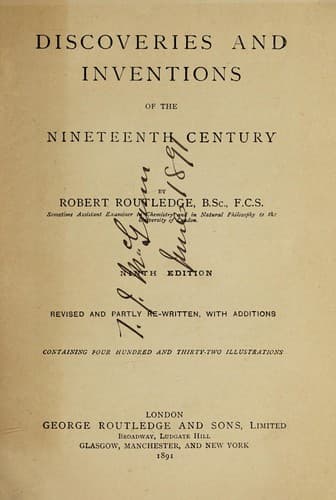
Discoveries and Inventions of the Nineteenth CenturyRoutledge, Robert
History
Discoveries and Inventions of the Nineteenth Century
Routledge, Robert
Inventions -- History -- 19th century
The foregoing calculation however involves an assumption not in exact
conformity with actual conditions, by taking for granted that the
_centre of gravity_ of the rifle is in the line of the axis of the
barrel, while in fact this centre is almost always lower, and therefore
the kick of the recoil acts in part as a turning-over push, tending to
tilt up the muzzle of the gun, and for that reason the firer must hold
the weapon very firmly or he will miss his aim. When such a rifle as we
have supposed is fired, say from the shoulder, it would follow from the
above calculation that the backward kick of the recoil is equivalent to
a blow from a 10–lb. weight moving at the speed of 7½ ft. per second.
This would certainly be a very uncomfortable experience, but the
backward momentum must be met somehow. We have supposed that the gun is
free to move, but we know the firer presses it firmly against the
muscles of his shoulder, and the stock of the gun is spread out and
provided with a smooth hollow heel plate, so that any pressure from it
is felt as little as possible, especially as the muscle against which it
is applied acts as an elastic pad. With the rifle thus firmly held we
may regard the marksman and his rifle as forming only _one mass_, and
the centre of gravity of this being now much below the axis of the
barrel, the effect of the recoil tends to overthrow the man backwards;
but he learns to resist this by standing firmly, so that the elasticity
of his whole frame comes into play; and besides this, the mass factor of
the momentum being now so large, the velocity factor becomes
comparatively insignificant.
Although the momenta of gun and projectile are, according to Newton’s
law, _equal_ and opposite, the case is very different with regard to
their _energies_, or powers of doing work, for the measure of these is
jointly mass and _the square of the velocity_. The _energy_ (_vis viva_)
of a body of weight in pounds = W, moving with the velocity of v feet
per second is always Wv^2/64·4, that is, it will do this number of
foot-lbs. units of work before it comes to rest. It would require too
much space to demonstrate and fully explain here what this means, but
the reader may refer to our index under the entries “Energy” and “Work,”
or to any modern elementary treatise on dynamics. If the calculation be
made of the energies of the ball and of the rifle due to our calculated
velocities of recoil, it will be found that that of the ball is 160
times greater than that of the other, and the ball possesses this energy
in a much smaller compass.
[Illustration:
FIG. 80.—_Trajectory of a Projectile._
]
Public-domain text, read in full here on John Shaqi.
Reviews
Reviews
No reviews yet
Be the first to share your thoughts on this work.
Elsewhere in the archive
Join the Discussion
Join the discussion
Sign in to leave a comment or review.
Sign InorCreate an account