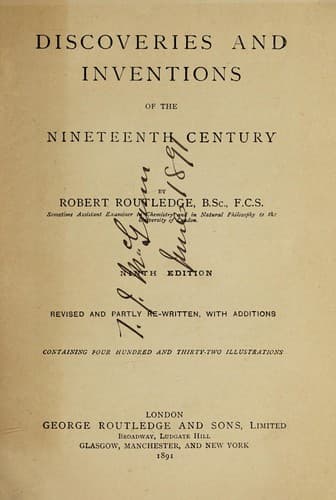
Discoveries and Inventions of the Nineteenth CenturyRoutledge, Robert
History
Discoveries and Inventions of the Nineteenth Century
Routledge, Robert
Inventions -- History -- 19th century
The bullets in both cases were spherical,
and as the earlier pattern had a seven-grooved barrel, there was so much
difficulty in introducing the bullets into the muzzles that mallets had
to be used. The bullet of the Brunswick rifle was encircled by a
projecting band, which fitted into two rather deep grooves diametrically
opposite to each other in the barrel. This bullet, wrapped in some
slightly greased material, could be readily dropped into the muzzle, and
rammed home without difficulty. Moreover, whereas in Baker’s rifle the
grooves made only a quarter of a turn in the length of the barrel, the
grooves of the Brunswick rifle made more than one complete turn. This
was so much an improvement on “Brown Bess” that the effective range was
more than doubled. For the rank and file of the infantry regiments the
flint-lock smooth-bore musket was, however, the regulation weapon until
1842, when it was superseded by the percussion musket. The
percussion-cap is now comparatively little used, as, since the
introduction of cartridges containing their own means of ignition, it is
rapidly becoming a thing of the past. The copper percussion-cap, in the
form it still retains, was invented about 1816, and was universally
adopted for sporting-guns a long time before it was used for the
military weapon. In 1842 the percussion musket was definitely adopted as
the weapon of the British army, but up to that date the flint-locks
still continued to be made at Birmingham.
The barrel of the percussion musket then issued was shortly afterwards
rifled, when about the year 1852 the Minié system was adopted, and the
Government awarded to M. Minié, a Frenchman, the sum of £20,000 for the
bullet he had invented. What the meaning of this improvement was may now
be explained, and we must begin by mentioning the various forms of
grooving, or, at least, such forms as found some approval during the
present century, for grooved barrels had been tried long before. At
first the grooves appear to have been intended merely to receive the
fouling, and these were often made without any twist or spiral, but
parallel to the axis of the barrel. The grooves are hollow channels of
greater or less depth, and of various forms; square, triangular,
rounded, or of such a form that the inner line of a section of the
barrel would present the form of a ratchet wheel. The numbers of the
grooves made use of have varied between two and twelve, or more, and
different rates of twist, or numbers of turns of the spiral in the
length of the barrel have been resorted to, these ranging from half a
turn to twelve turns. The Brunswick rifle had been found wanting in
accuracy, when at length in 1846 General Jacobs proposed the adoption of
the conical bullet with projecting spiral ridges which fitted into
grooves cut in the rifle barrel. The difficulty in using muzzle-loading
rifles consisted in the force required to ram down the bullet, which had
Public-domain text, read in full here on John Shaqi.
Reviews
Reviews
No reviews yet
Be the first to share your thoughts on this work.
Elsewhere in the archive
Join the Discussion
Join the discussion
Sign in to leave a comment or review.
Sign InorCreate an account