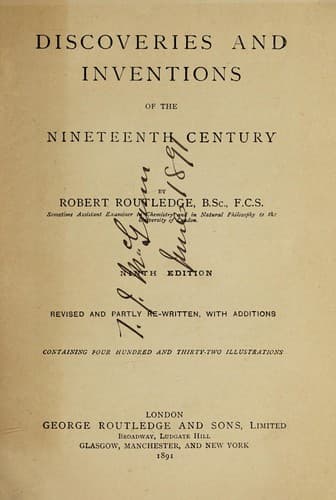
Discoveries and Inventions of the Nineteenth CenturyRoutledge, Robert
History
Discoveries and Inventions of the Nineteenth Century
Routledge, Robert
Inventions -- History -- 19th century
When the piece has not to be
fired immediately, the lever is not placed horizontally, but in an
inclined position, in which the hammer cannot move forward, even if the
trigger be drawn. The Chassepot has an effective range of 1,093 yards,
and the projectile leaves the piece with a velocity of 1,345 ft. per
second, the trajectory being such that at 230 yards the bullet is only
18 in. above the straight line. The piece can be charged and fired by
the soldier in any position, and it was found that it could be
discharged from seven to ten times per minute, even when aim was taken
through the sights with which it is furnished, and fourteen or fifteen
times per minute without sighting. The ordinary rifled musket, which
this arm superseded, could only be fired twice in a minute, and could
only be loaded when the soldier was standing up.
Other nations followed either by adopting as their infantry arm some
form of breech-loader, or by converting their muzzle-loaders into
breech-loaders as a temporary expedient, pending the selection of some
more perfect type. When in 1864 a committee which had been appointed to
investigate the question of proper arms for our infantry, recommended
that that branch of the service should be supplied with breech-loaders,
our Government, considering that no form of breech-loader had up to that
time been invented which would unequivocally meet all the requirements
of the case, wisely determined that, pending the selection of a suitable
arm, the service muzzle-loaders should meanwhile be converted into
breech-loaders. The problem of how this was to be done was solved by the
gunmaker Snider, and in the “Converted Enfield” or “Snider” the British
army was provided for a time with an arm satisfying the requirements of
that period. This change of weapon was effected at a comparatively small
outlay, for the conversion cost less than twenty shillings an arm. The
breech action in the Snider consisted of a solid piece of metal which
closed the breech end of the barrel, and, being hinged on the right-hand
side parallel to the barrel, could be turned aside, making room for the
insertion into the conically widened bore of a metallic cartridge case,
invented by Colonel Boxer, which contained the projectile, the powder
charge, and the means of ignition in itself. A short backward movement
of the breech-lock caused a claw acting on the base of the spent
cartridge case to withdraw it from the barrel, and then the reaction of
a spring brought the breech-block back into position, after insertion of
a new cartridge. This cartridge proved very effective in increasing the
range and accuracy of the weapon. It should be mentioned that all the
breech-loading mechanisms are provided with arrangements by which the
metallic cases of the spent cartridges are automatically extracted from
the barrel. The authorities having, in 1866, offered gunmakers and
others handsome prizes for the production of rifles best fulfilling
Public-domain text, read in full here on John Shaqi.
Reviews
Reviews
No reviews yet
Be the first to share your thoughts on this work.
Elsewhere in the archive
Join the Discussion
Join the discussion
Sign in to leave a comment or review.
Sign InorCreate an account