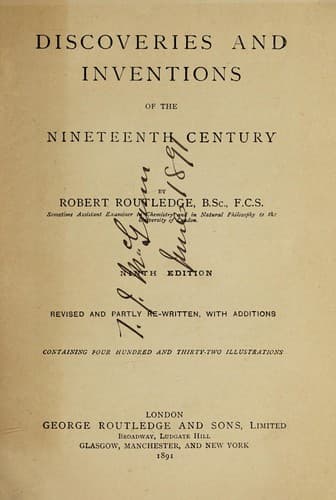
Discoveries and Inventions of the Nineteenth CenturyRoutledge, Robert
History
Discoveries and Inventions of the Nineteenth Century
Routledge, Robert
Inventions -- History -- 19th century
As an evidence of the accuracy of fire in this rifle, it may be stated
that of twenty shots fired at 1,200 yards, the mean absolute deflection
of the hits from the centre of the group was 2·28 ft. The highest point
in the trajectory at 500 yards is rather over 8 ft. so that the bullet
would not pass over a cavalry soldier’s head within that distance. The
trajectory of the Snider at the same range rises to nearly 12 ft. The
bullet will pass through from thirteen to seventeen ½ in. elm planks
placed 1 in. apart at 20 yards distance; the number pierced by the
Snider under similar circumstances being from seven to nine. As regards
rapidity of fire, twenty rounds have been fired in 53 seconds; and one
arm which had been exposed to rain and water artificially applied for
seven days and nights, and had during that time fired 400 rounds, was
then fired, without cleaning, twenty rounds in 1 minute 3 seconds.
Rifles of the Martini-Henry and Chassepot type were soon superseded, for
as early as 1876 Switzerland had armed her troops with a magazine rifle
of a smaller calibre than any then in use, and this weapon was found so
effective that in a few years after every European nation had followed
suit, as also had the United States and Japan, each country adopting
some particular pattern of a weapon with certain modifications. Of these
the Mannlicher and the Mauser are much used. A magazine rifle is one
that can be fired several times successively without reloading. Like
revolvers, the magazine arms repeat their fire, but instead of having
several distinct firing chambers, they have but one, from which the
empty cartridge cases are automatically extracted by the breech
mechanism, for the magazine rifle is necessarily a breech-loader. The
magazine rifle carries a supply of cartridges, which one after another
are brought into the firing chamber by the simple action of the breech
mechanism, so that the soldier is enabled to discharge several rounds in
any position without reloading. The several varieties of the magazine
rifle may be classed according to the position of the magazine. This may
be: First, in the stock; second, under the barrel; third, in a box under
the breech; or fourth, in a box above the breech. In the first and
second variety the cartridges are in line in a tube, out of which they
are moved on by a spiral spring, and this was the earlier form of the
weapon. The box above or below the breech is the later development, and
has the advantage of holding the cartridges lying side by side, and thus
in a position in which they are not so liable to injure each other as in
the tubular arrangements. Then, again, the movement of the cartridge in
the breechbox in arriving at the firing chamber is much less than in the
linear magazines, and the centre of gravity of the whole changes but
little when the supply is exhausted. With any of the varieties of
magazine a suitable modification of the mechanism may be adopted, so
Public-domain text, read in full here on John Shaqi.
Reviews
Reviews
No reviews yet
Be the first to share your thoughts on this work.
Elsewhere in the archive
Join the Discussion
Join the discussion
Sign in to leave a comment or review.
Sign InorCreate an account