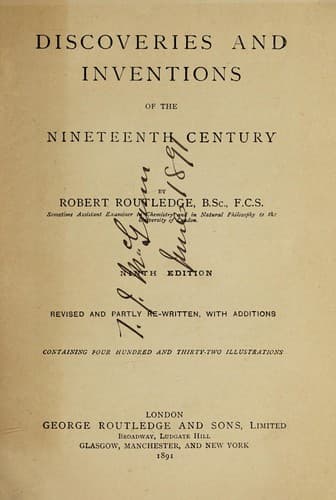
Discoveries and Inventions of the Nineteenth CenturyRoutledge, Robert
History
Discoveries and Inventions of the Nineteenth Century
Routledge, Robert
Inventions -- History -- 19th century
all guns on the enemy’s side when they had been _trained_ (by rough
methods), so as to concentrate their effect as much as possible on one
point of the antagonist. Nelson’s famous ship the _Victory_ carried a
few larger guns than the 32–pounders, namely, two 68–pounders, called
_carronades_ (from having first been cast at Carron in Scotland), and
some 42–pounders. The 32– and 42–pounders numbered together thirty, and
there were also as many 24–pounders, with forty 12–pounders. These were
all simply cast of the required dimensions, and were not made with the
one single improvement which after two centuries’ use of cast-iron guns
had been introduced into France about fifty years before, namely, the
_boring_ of the chase out of a solid casting.
On the outbreak of the Crimean War (1854) the minds of many inventors
were occupied by the problem of ordnance construction, and this also
engaged the attention among others of two of the most eminent British
mechanical engineers of the day. These were Sir W. Armstrong and Sir J.
Whitworth, who, with others, were invited by our War Department to
submit the best models of field and heavy guns their skill was severally
able to produce. Two years afterward, Sir W. Armstrong had, after many
experiments, completed a gun of 1·88 in. calibre. This had a forged
steel barrel 6 feet in length; but it was only after eight such forgings
had been bored and rejected on account of flaws revealed only by the
boring that a sound barrel was at length obtained. This barrel was
strengthened on the outside by _jackets_ made from coils of wrought iron
bars welded into a piece and shrunk on while hot (of which process we
shall have something more to say presently); the barrel was rifled with
many shallow grooves, and the pointed projectile, 3 calibres long, was
made of lead, for which afterwards iron coated with lead was
substituted. This gun was a breech-loader, the breech being closed by a
block let into a slot after loading, and then pressed against the barrel
by some turns of a screw which advanced parallel to the axis of the
piece, and was made hollow for loading through, before the closing block
was put in. In a trial of the various pieces ready in 1857, it was found
that the Armstrong gun made as just described had an accuracy and range
immensely greater than any weapon that had ever been tested, and the
Government authorities approved of the system of construction, except
that they preferred muzzle-loading pieces to breech-loading, as being
simpler in action, more easily kept in repair, and cheaper in original
cost and ammunition.
Public-domain text, read in full here on John Shaqi.
Reviews
Reviews
No reviews yet
Be the first to share your thoughts on this work.
Elsewhere in the archive
Join the Discussion
Join the discussion
Sign in to leave a comment or review.
Sign InorCreate an account