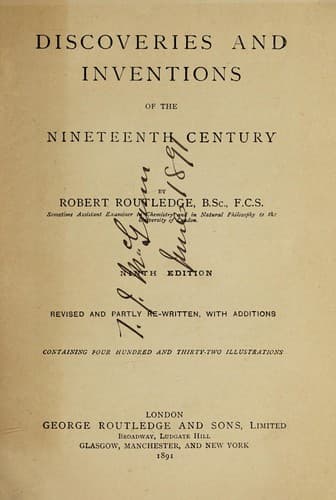
Discoveries and Inventions of the Nineteenth CenturyRoutledge, Robert
History
Discoveries and Inventions of the Nineteenth Century
Routledge, Robert
Inventions -- History -- 19th century
FIG. 92.—_600–pounder Muzzle-loading Armstrong Gun._
]
About the year 1858 Sir William Armstrong (afterwards Lord Armstrong)
established at Elswick, Newcastle-on-Tyne, a manufactory of ordnance,
which has since developed into the great arsenal now so well known all
over the world. Here all the resources of science have been applied to
the problems of artillery, and experiments carried on with a prodigality
of cost and promptness of execution impossible at a government
establishment trammelled with official regulations. Here, and also at
Woolwich, our national ordnance factory, guns have since always been
constructed on the building-up plan advocated by Sir W. Armstrong, whose
principle consists in disposing of the fibre of the iron so as best to
resist the strains in the several parts of the gun. Wrought iron being
fibrous in its texture has, like wood, much more strength in the
direction of the grain than across it. The direction of the fibre in a
bar of wrought iron is parallel to its length, and in that direction the
iron is nearly twice as strong as it is transversely. A gun may give way
either by the bursting of the barrel or by the blowing out of the
breech. The force which tends to produce the first effect acts
transversely to the axis of the gun; hence the best way to resist it is
to wrap the iron round the barrel, so that the fibres of the metal
encircle it like the hoops of a cask. The force which tends to blow out
the breech is best resisted by disposing the fibres of the iron so as to
be parallel to the axis of the gun; hence Sir W. Armstrong makes the
breech-piece from a solid forging with the fibre in the required
direction. But the Elswick building-up principle involves much more than
the direction of the fibres of the iron, for each coil or jacket, after
having its spires welded together, was bored out on a lathe, and the
exterior of the part of the gun on which it was to be placed was also
turned with the utmost exactness, so that when the enveloping piece was
heated to a certain temperature and in this state brought into position,
it would in cooling compress the parts it encircled just to that degree
which careful calculations showed would best strengthen the gun without
unduly straining the metal at any part. The Elswick guns being built up
of several superimposed jackets of calculated lengths and thicknesses,
the means was afforded of distributing the tensions throughout the whole
mass of metal to the best advantage. In the simpler form, arranged by
Mr. Fraser, and for the sake of economy adopted by the authorities at
Woolwich in 1867, the greater part of the benefit derivable from
adjustment of tension was no doubt sacrificed to cheapness of
manufacture. These, and also the forms of Armstrong guns that have not
yet been described, ceased to be made after 1880, by which time steel
had replaced iron in every part of the construction and fittings of
guns, and muzzle-loading had been definitely abandoned in favour of
Public-domain text, read in full here on John Shaqi.
Reviews
Reviews
No reviews yet
Be the first to share your thoughts on this work.
Elsewhere in the archive
Join the Discussion
Join the discussion
Sign in to leave a comment or review.
Sign InorCreate an account