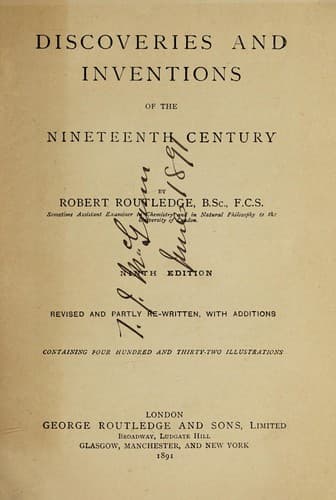
Discoveries and Inventions of the Nineteenth CenturyRoutledge, Robert
History
Discoveries and Inventions of the Nineteenth Century
Routledge, Robert
Inventions -- History -- 19th century
The 81–ton gun was the largest muzzle-loader ever made in the national
gun factory at the time when such huge weapons were in request; but in
1876 its dimensions were surpassed by those of a few 100–ton guns built
at Elswick to the order of the Italian Government for mounting on their
most formidable ironclads. These guns have a calibre of 17·72 inches,
and are provided with a chamber of somewhat larger bore to receive the
charge of powder. They are built up on the Armstrong shrinkage
principle, and comprise as many as twenty different tubes, jackets,
hoops, screws, etc., and are undoubtedly the most powerful
muzzle-loading weapons ever constructed. It happened, just as these guns
were completed, that the British Government, apprehensive at the time of
a war with Russia, exercised its rights of purchasing two of them, one
to be mounted at Gibraltar, the other at Malta.
The Elswick establishment soon afterwards surpassed all its former
achievements in building great guns, by designing and constructing the
huge breech-loaders, one of which forms the subject of our Plate XII.
These are known as the Armstrong 110–ton guns; they are formed of solid
steel throughout, and their weight is accurately 247,795 lbs., or 110
tons 12 cwts. 51 lbs. The total length of the gun is 43 ft. 8 in., and
of this 40 ft. 7 in. is occupied by the bore, along which the rifling
extends 33 ft. 1 in. The calibre of the rifled part is 16¼ in., and the
diameter of the powder chamber is somewhat greater. The regulation
charge of powder weighs 960 lbs., although the guns are tested with
still greater charges. The weight of the projectile is 1,800 lbs., and
it leaves the muzzle with a velocity of 2,128 ft. per second, which is
equivalent to a dynamical energy of 56,520 foot-tons. What this means
will perhaps be better understood, not by describing experiments such as
those on the Millwall Shield, the results of which are depicted in Figs.
95 and 96, but by stating that if the shot from the 110–ton gun
encountered a solid wall of wrought iron a yard thick, it would pass
through it. The Elswick 110–ton gun is, in fact, the most powerful piece
of ordnance that has ever been constructed. There are no trunnions to
these great guns, but they are encircled by massive rings of metal,
between which pass strong steel bands that tie the gun to its carriage,
or, rather, to the heavy steel frame on which it is mounted, and which
slides on a couple of girders. The force of the recoil acts on a
hydraulic ram that passes through the lower part of the supporting
frame. The whole working of the gun is done by hydraulic power, and,
indeed, the same method has been applied by the Elswick firm to the
handling of all heavy guns. By hydraulic power, maintained automatically
by a pumping engine exercising a pressure of from 800 lbs. to 1,000 lbs.
per square inch, are operated the whole of the movements required for
bringing the cartridge and the projectile from the magazine; for
Public-domain text, read in full here on John Shaqi.
Reviews
Reviews
No reviews yet
Be the first to share your thoughts on this work.
Elsewhere in the archive
Join the Discussion
Join the discussion
Sign in to leave a comment or review.
Sign InorCreate an account