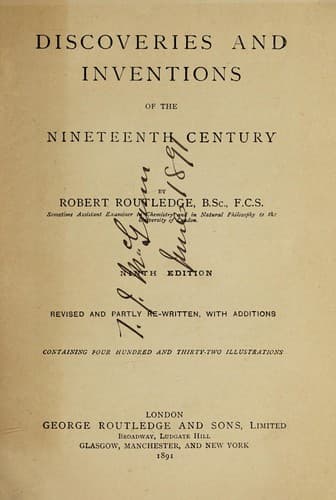
Discoveries and Inventions of the Nineteenth CenturyRoutledge, Robert
History
Discoveries and Inventions of the Nineteenth Century
Routledge, Robert
Inventions -- History -- 19th century
The operations required in constructing guns are multiform, and have to
be very carefully conducted so that the workmanship shall be of the best
quality. The finest ores are selected for reduction, and the steel is
obtained by the Siemens-Martin process already described. It must be
free from sulphur and phosphorus, and contain such proportions of
carbon, silicon, and manganese as experience has shown to be best, and
its composition is ascertained by careful chemical analysis before it is
used. The fluid steel is run into large ladles lined with fire-brick,
and provided with an opening in the bottom from which the metal can be
allowed to run out into the _ingot_ moulds, the size and proportions of
these being in accordance with the object required; some admitting of as
much as 80 tons at one operation. When a barrel or hoop is required of
not less than 6 inches internal diameter the ingot is cut to the
required length and roughly bored. The ingot is then heated, a long
cylindrical steel bar is put through the hole, and under a hydraulic
press the hot metal is squeezed into greater length and less diameter.
The hole first bored through the ingot is of somewhat greater, and the
steel bar (called a mandril) of less, diameter than required in the
finished piece. Portions are cut from each end of what is now called the
_forging_ and subjected to mechanical tests: if these are satisfactory,
the forging is rough bored and turned on the outside. It is then
annealed, by being heated and allowed to cool very slowly. The next
operation is to _harden_ the metal by raising it to a certain
temperature, at which it is immersed in rape oil until cold. Then the
piece is again annealed, and fine-turned and bored. All these operations
have to be performed not only on the barrel, but also on each hoop,
before the hoops are shrunk on, and the greatest nicety of measurement
is required in each piece. Then the gun has to be turned on the outside,
the screw for the breech piece cut, the bore rifled, etc. The object of
the annealing is to relieve the metal from internal strains. It will not
be wondered at that months are required for the construction of the
larger kind of guns. Thus at Elswick a 6 in. quick firing gun, upon
which men are employed night and day, cannot be completed in less than
five months, and sixteen months are required for making a 67–ton gun.
Public-domain text, read in full here on John Shaqi.
Reviews
Reviews
No reviews yet
Be the first to share your thoughts on this work.
Elsewhere in the archive
Join the Discussion
Join the discussion
Sign in to leave a comment or review.
Sign InorCreate an account