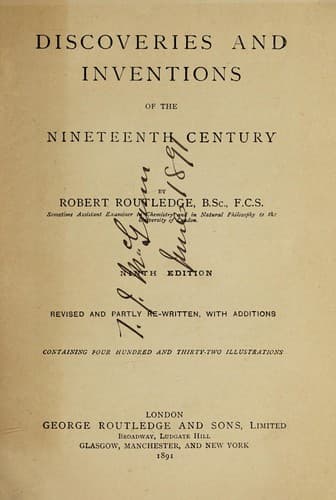
Discoveries and Inventions of the Nineteenth CenturyRoutledge, Robert
History
Discoveries and Inventions of the Nineteenth Century
Routledge, Robert
Inventions -- History -- 19th century
Details cannot here be given even of the method by which
the valves in the recoil cylinders are automatically controlled for this
purpose. Means are also supplied for setting the gun, while still in its
protected position, to the required angle of elevation or depression.
The adjustment is made by the long rods attached near the breech and set
at their lower ends to the position giving the intended angle to the
raised gun. The varied and powerful strains to which the parts of this
mechanism are subject, and which have had to be calculated and provided
for, may be inferred from the enormous recoil energy of the gun, which
under ordinary conditions amounts to no less than 730 foot-tons. The gun
is provided with ordinary, and also with reflecting, sights, so that no
one need be exposed to the enemy’s fire. Protective armour above the gun
is not required, as the pit itself being usually on some elevation is
imperceptible to the enemy, and the gun is visible but for a few
seconds, forming a quite inconspicuous object. The pit in which the gun
is mounted is commonly lined with concrete. Italy, England, Norway,
Japan and other countries have appreciated the advantages of the
disappearing system in providing the most powerful coast defences yet
devised, and a great many guns have been mounted on this principle.
[Illustration:
FIG. 102.—_68–ton Gun on Elswick Hydro-Pneumatic Mounting._
]
An extraordinary piece of ordnance is represented in Fig. 103. It is one
of two huge mortars, the idea of which presented itself to Mr. Mallet
during the Crimean War, the intention being to throw into the Russian
lines spherical shells a yard in diameter, which would, in fact, have
constituted powerful mines, rendering it impossible for the
fortifications to continue tenable. Mallet’s original design was to
project these shells from mortars of no less than 40 tons weight. When
it was pointed out that the transport of so heavy a mass would be
impracticable, the design was changed to admit of the mortar being made
in pieces not exceeding eleven tons in weight, and built up where
required. During the most active period in the siege of Sebastopol this
plan was submitted to Lord Palmerston, who at once ordered two of these
apparently formidable pieces to be constructed, without waiting for
official examinations of the scheme, and the usual reports of
experts,—promptness in this case being considered of the utmost
importance. A contract was made with a private firm, who undertook to
deliver them in ten weeks. But the difficulties attending such
constructions not being understood at the time, delays arose, the
contractors failed, and two years elapsed before the mortars were
completed. In the meantime peace had been concluded, and the mortars
were never fired against any hostile works; but experiments were made
with one of them at Woolwich. The heaviest of the shells it was intended
to project weighed 2,940 lbs., and for this it was proposed to use a
charge of 80 lbs.
Public-domain text, read in full here on John Shaqi.
Reviews
Reviews
No reviews yet
Be the first to share your thoughts on this work.
Elsewhere in the archive
Join the Discussion
Join the discussion
Sign in to leave a comment or review.
Sign InorCreate an account