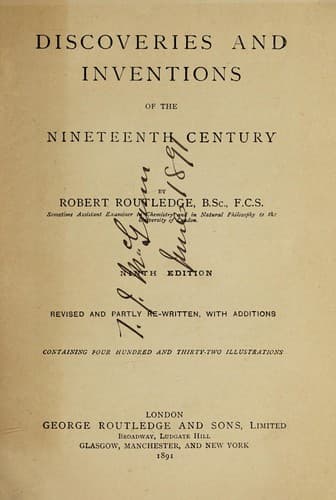
Discoveries and Inventions of the Nineteenth CenturyRoutledge, Robert
History
Discoveries and Inventions of the Nineteenth Century
Routledge, Robert
Inventions -- History -- 19th century
The name of machine guns has been applied to arms which may be regarded
as in some respects intermediate between cannons and rifles, since in
certain particulars they partake of the nature of both. Like the former,
they are fired from a stand or carriage, and in some of their forms
require more than one man for their working: in the calibre of their
barrels and the weight of their projectiles, they are assimilated to the
rifle, but they are capable of pouring forth their missiles in a very
rapid succession—so rapid indeed as practically to constitute volley
firing. The firing mechanism of the machine gun has always an automatic
character, but the rifle has acquired this feature, so that it cannot be
made a distinguishing mark: on the other hand, since machine guns have
been made to discharge projectiles of such weights as 1 lb. or 3 lb.
there is nothing to separate them from quick-firing ordnance unless it
be the automatic firing.
The idea of combining a number of musket-barrels into one weapon, so
that these barrels may be discharged simultaneously or in rapid
succession, is not new. Attempts were made two hundred years ago to
construct such weapons; but they failed, from the want of good
mechanical adjustments of their parts. Nor would the machine gun have
become the effective weapon it is, but for the timely invention of the
rigid metallic-cased cartridge. Several forms of machine guns have in
turn attracted much attention. There is the Mitrailleur (or
Mitrailleuse), of which so much was heard at the commencement of the
Franco-German War, and of whose deadly powers the French managed to
circulate terrible and mysterious reports, while the weapon itself was
kept concealed. Whether this arose from the great expectations really
entertained of the destructive effects of the mitrailleur, or whether
the reports were circulated merely to inspire the French troops with
confidence, would be difficult to determine. Our own policy in regard to
new implements of war is not to attempt to conceal their construction.
Experience has shown that no secret of the least value can long be
preserved within the walls of an arsenal, although the French certainly
apparently succeeded in surrounding their invention with mystery for a
while. The machine gun, or “battery,” invented by Mr. Gatling, an
American, is said by English artillerists to be free from many defects
of the French mitrailleur. In 1870 a committee of English military men
was appointed to examine the powers of several forms of mitrailleur,
with a view to reporting upon the advisability or otherwise of
introducing this arm into the British service. They recommended for
certain purposes the Gatling battery gun.
[Illustration:
FIG. 105_b_.—_The Gatling Gun.—Rear View._
]
Public-domain text, read in full here on John Shaqi.
Reviews
Reviews
No reviews yet
Be the first to share your thoughts on this work.
Elsewhere in the archive
Join the Discussion
Join the discussion
Sign in to leave a comment or review.
Sign InorCreate an account