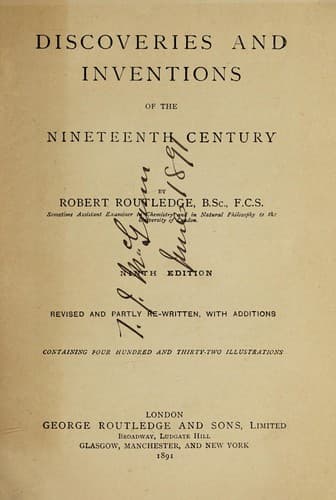
Discoveries and Inventions of the Nineteenth CenturyRoutledge, Robert
History
Discoveries and Inventions of the Nineteenth Century
Routledge, Robert
Inventions -- History -- 19th century
The notion of destroying ships or other structures by explosions of
gunpowder, contained in vessels made to float on the surface of the
water, or submerged beneath it, is not of very modern origin. Two
hundred and fifty years ago the English tried “floating petards” at the
siege of Rochelle. During the American War of Independence similar
contrivances were used against the British, and from time to time since
then “torpedoes,” as they were first termed by Fulton, have been
employed in warfare in various forms; but up to quite a recent period
the use of torpedoes does not appear to have been attended with any
decided success, and it is probable that but for the deplorable Civil
War in the United States we should have heard little of this invention.
During that bitter fratricidal struggle, however, when so much ingenuity
was displayed in the contrivance of subsidiary means of attack and
defence, the torpedo came prominently into notice, having been employed
by the Confederates with the most marked effects. It is said that
thirty-nine Federal ships were blown up by Confederate torpedoes, and
the official reports own to twenty-five having been so destroyed. This
caused the American Government to turn their attention to the torpedo,
and they became so convinced of the importance of this class of war
engine that they built boats expressly for torpedo warfare, and equipped
six _Monitors_ for the same purpose.
It has been well remarked that the torpedo plays the same part in naval
warfare as does the mine in operations by land. This exactly describes
the purpose of the torpedo where it is used defensively, but the
comparison fails to suggest its capabilities as a weapon of offence.
There are few occasions where a mine is made the means of attack, while
the torpedo readily admits of such an employment, and, used in this way,
it may become a conspicuous feature of future naval engagements. Many
forms of this war engine have been invented, but all may be classified,
in the first place, under two heads: viz., stationary torpedoes, and
mobile or offensive torpedoes; while independent distinctions may be
made according to the manner of firing the charge; or, again, according
to the mode of determining the instant of the explosion. The stationary
torpedo may be fixed to a pile or a raft, or attached to a weight; the
offensive torpedo may be either allowed to float or drift against the
hostile ships, or it may be propelled by machinery, or attached to a
spar of an ironclad or other vessel. The charge may be fired by a match,
by percussion, by friction, by electricity, or by some contrivance for
bringing chemicals into contact which act strongly upon each other, and
thus generate sufficient heat to ignite the charge. The instant of
explosion may be determined by the contact of the torpedo with the
hostile structure (in which case it is said to be “self-acting”), or by
clockwork, or at the will of persons directing the operations. In some
Public-domain text, read in full here on John Shaqi.
Reviews
Reviews
No reviews yet
Be the first to share your thoughts on this work.
Elsewhere in the archive
Join the Discussion
Join the discussion
Sign in to leave a comment or review.
Sign InorCreate an account