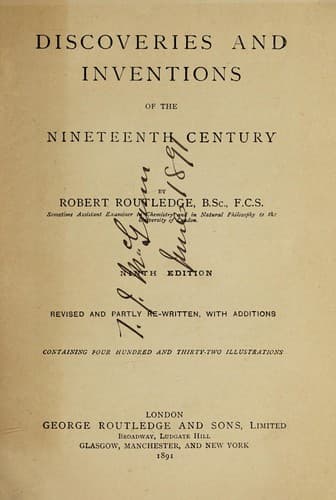
Discoveries and Inventions of the Nineteenth CenturyRoutledge, Robert
History
Discoveries and Inventions of the Nineteenth Century
Routledge, Robert
Inventions -- History -- 19th century
The employment of torpedoes develops, as a matter of course, a system of
defence against them. Nets spread across a channel will catch drifting
torpedoes, and stationary ones may be caused to explode harmlessly by
nets attached to spars pushed a great distance forward from the
advancing ship.
Before the final adoption of Whitehead’s torpedo, presently to be
described, the British Government had, after various official trials,
approved of a towing torpedo designed for offensive operations. It is
the invention of Commander Harvey, and is worthy of a detailed
description for the ingenuity of its construction.
[Illustration:
FIG. 113.—_Explosion of 432 lbs. of Gun-Cotton in 37 feet of Water._
]
[Illustration:
FIG. 114.—_Explosion of 432 lbs. of Gun-Cotton in 27 feet of Water._
]
The shape of Harvey’s torpedo, as may be noticed on reference to Fig.
118, is not symmetrical, but it has some remote resemblance to a boat,
though constructed with flat surfaces throughout. The outside case is
formed of wood well bound with iron, all the joints being made
thoroughly water-tight. The length is 5 ft. and the depth 1¾ ft., while
the breadth is only 6 in. Within this wooden case is another water-tight
case made of thick sheet copper, from the top of which two very short
wide tubes pass upwards to what we may term the deck of the wooden case.
These are the apertures through which the charge of gunpowder or other
explosive material is introduced; and when the tubes have been securely
stopped with corks, brass caps are screwed on. The centre of the
internal case is occupied by a copper tube, _g_, Fig. 115, which passes
the entire depth, and is soldered to the top and bottom of the copper
case, so that the interior of the tube has no communication with the
body of the torpedo, the principal charge merely surrounding it. Thus
the tube forms a small and quite independent chamber in the midst of the
large one, which latter is capable of containing 80 lbs. of gunpowder.
The copper tube or priming-case contains also a charge, _a_, which when
exploded bursts the tube, and thus fires the torpedo in its centre. The
priming charge is put in from the lower end of the tube, which is
afterwards closed by a cork and brass cap, _h_; for the centre of the
priming-case is occupied by a brass tube, _b_, closed at the bottom, but
having within a pointed steel pin projecting upwards. In this tube works
the exploding bolt _c d_, which requires a pressure of 30 or 40 lbs. to
force it down upon the steel pin. This pressure is communicated to the
bolt by the straight lever working in the slot at its head, _d_, and
itself acted on at its extremity by the curved lever to which it is
attached. Thus from the mechanical advantage at which the levers act a
moderate downward pressure suffices to force the exploding bolt to the
bottom of the brass tube. The lower end of this bolt has a cavity
containing an exploding composition sufficient in itself to fire the
Public-domain text, read in full here on John Shaqi.
Reviews
Reviews
No reviews yet
Be the first to share your thoughts on this work.
Elsewhere in the archive
Join the Discussion
Join the discussion
Sign in to leave a comment or review.
Sign InorCreate an account