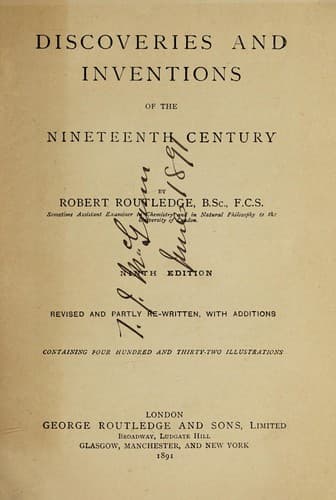
Discoveries and Inventions of the Nineteenth CenturyRoutledge, Robert
History
Discoveries and Inventions of the Nineteenth Century
Routledge, Robert
Inventions -- History -- 19th century
The compartment immediately behind the “steering chamber” contains the
engines which are of the Brotherhood type, provided with _three_ single
acting cylinders. The three-fold throw prevents any possibility of the
engine getting on a “dead point.” Though this compartment is the
shortest in the torpedo, the engines in the larger sizes are capable of
indicating as much as thirty horse power. It has for simplicity been
stated above that the pendulous weight and the balanced piston act by
means of rods on the horizontal rudder; this was so in the early
patterns of the torpedo, but it was soon found that they did not do so
with sufficient steadiness and promptitude, and the force they could
apply was in the larger and swifter forms quite ineffective. Nowadays
the engine compartment always contains a little piece of apparatus which
is an arrangement of cylinder and piston, upon which the compressed air
acts in one or the other direction according to the way its slide-valve
is moved. It is this slide-valve that the rods from the “steering
chamber” move, and allow the force of the compressed air to turn the
rudder up or down. This auxiliary apparatus has the same relation to the
torpedo rudder that the steam-steering apparatus of a large vessel has
to its rudder. Although it is only about a few inches long, its power
and delicacy are such that the pressure of half an ounce on its slide
admits to its piston a force equal to 160 lbs., and its introduction has
given the torpedo the power of steadily steering itself.
Behind the engine compartment, but completely shut off from it, is
another almost empty division occupying a considerable part of the
length of the torpedo, and known as the “buoyancy chamber.” But it
contains, attached to the bottom of it, a certain amount of ballasting,
so adjusted to balance the weights of the other parts that the whole
floats horizontally, and at the same time preserving the tube in one
vertical position as regards its transverse diameter, _i.e._, so that
the horizontal rudder is always horizontal. The shaft from the engine
passes through this compartment, as also the rod from the small motor
that moves the horizontal rudder. These, of course, pass through
water-tight bearings.
Public-domain text, read in full here on John Shaqi.
Reviews
Reviews
No reviews yet
Be the first to share your thoughts on this work.
Elsewhere in the archive
Join the Discussion
Join the discussion
Sign in to leave a comment or review.
Sign InorCreate an account