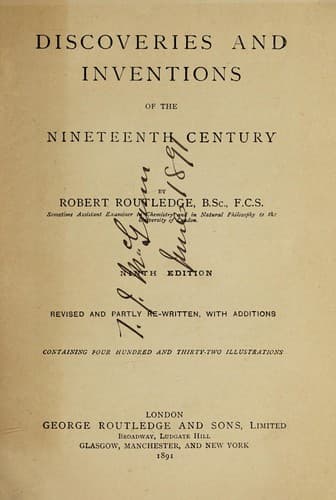
Discoveries and Inventions of the Nineteenth CenturyRoutledge, Robert
History
Discoveries and Inventions of the Nineteenth Century
Routledge, Robert
Inventions -- History -- 19th century
The Suez Canal is 88 geographical, or about 100 statute miles long: its
average width is 25 yards, and the minimum depth, 26 feet. At intervals
of five or six miles, the canal is widened, for a short space, to 50
yards, forming thus sidings (_gares_) where only vessels can pass each
other. At these, therefore, a ship has often to wait until a file of
perhaps twenty steamers, coming the other way, has passed. Occasionally
a ship gets across, or “touches,” and then the canal is blocked for
hours. So much inconvenience has been found from the restricted
dimensions of the work, that in 1886 it was proposed to widen the canal,
or, alternatively, to construct a second canal, and use the two like the
lines of a railway, so that vessels would never have occasion to pass
each other. The amount of traffic is very large, and has been steadily
increasing. Thus, in 1874, the tonnage of the vessels passing through
was 5,794,400 tons; in 1880, the tonnage was 8,183,313, and the receipts
of the Company amounted to £2,309,218. In 1875, the British Government
purchased, from the Khedive, £4,000,000 worth of shares.
[Illustration:
FIG. 124.—_A Group of Egyptian Fellahs, and their Wives._
]
The Suez Canal is not so much a triumph of engineering as a monument of
successful enterprise and determination on the part of its great
promoter, M. Lesseps, in the face of great difficulties. According to
the original programme, the canal was to have been constructed by forced
labour, supplied by the Viceroy. The unhappy peasantry of the country,
called “fellahs,” were compelled to give their labour for a miserable
pittance of rice. No doubt, in ancient times, when forced labour was in
use, every peasant might cheerfully work, because it was for the general
benefit to bring sweet water from the Nile to other dry and thirsty
places in Egypt; but to be obliged to work at a waterway of salt, which
was only to be of use to foreigners who passed through the country,
could not be expected of human beings, and therefore the carrying out of
the work was not unaccompanied by cruelties of the nature attending
slave labour in other lands. This was one of the reasons why the late
Lord Palmerston opposed the canal scheme, for the kind hearted statesman
bore in mind the loss of health and life occasioned to poor Egyptians by
this mode of labour, and the more so because it had been originally
proposed that one of the conditions on which the French Company was to
take up the project should be the execution of the work by _free
labour_. In consequence, no doubt, of representations from free
countries, the Porte was induced to put a veto on the employment of
forced labour, and everyone thought that this would be the deathblow to
the completion of the canal: but M. Lesseps did not give way to despair,
and he since stated that if he had depended on the labours of the
fellahs only, the difficulties of the work never could have been
Public-domain text, read in full here on John Shaqi.
Reviews
Reviews
No reviews yet
Be the first to share your thoughts on this work.
Elsewhere in the archive
Join the Discussion
Join the discussion
Sign in to leave a comment or review.
Sign InorCreate an account