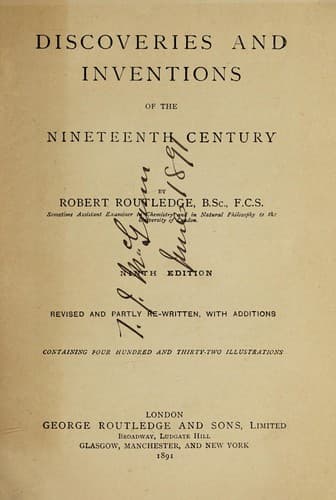
Discoveries and Inventions of the Nineteenth CenturyRoutledge, Robert
History
Discoveries and Inventions of the Nineteenth Century
Routledge, Robert
Inventions -- History -- 19th century
They were then drawn up the rails by an
endless rope, and as each truck reached the end of the rails its side
fell open, the mud was shot out upon the bank, and the empty truck
returned by another set of rails to the platform on which the elevator
was placed, and was thence lowered into the barge to which it belonged.
As the elevator could unload and re-load a barge much faster than the
dredges could fill it with mud, each elevator was fed by half a dozen
dredges, and thus the mud raised from the canal by several dredges was
carted away without difficulty at one and the same time. As these
floating dredges were much easier to shift than those encumbered by the
long _couloir_ pipes, the work of excavating the bed went on much more
rapidly. But in places where there was any great mass of earth or sand
to be removed, the large _couloirs_ could scoop out a given volume in a
shorter time.
The traveller who wishes to see the canal should go to France, and,
embarking at the port of Marseilles, cross the Mediterranean Sea, and
steam to Port Saïd, which is about 150 miles east of the port of
Alexandria, where the isthmus is crossed by the railroad, and is used by
travellers to India, being known as the “overland route.” And this
railway conveys the mail to and from India, thus saving the great sea
voyage round Africa and the Cape of Good Hope. Nevertheless, it involves
two transhipments—from the steamer to the rail at Alexandria, and from
the railway to the steamer at Suez.
[Illustration:
FIG. 127.—_Port Saïd, the Mediterranean entrance to the Suez Canal._
]
Let us notice in order the places passed by the traveller in going from
Port Saïd to Suez and the Red Sea. The arrow (Fig. 126) points in the
direction of the compass, and shows that the canal runs very nearly from
north to south. Port Saïd is the little town at the northern or
Mediterranean entrance to the canal, situated on the flat sands at the
entrance of the canal, and is built chiefly of wood, with straight wide
streets and houses, and although it now contains several thousand
inhabitants, before the making of the canal was begun one hundred people
could hardly have been got together. The town contains nothing deserving
of notice, and has a striking resemblance to the newly settled cities of
America. But in it reside agents who represent numerous varied
interests—administrative, financial, mercantile and political. It is
provided with docks, basins, quays and warehouses, and has a harbour
stretching out a couple of miles or so into the sea, for to that
distance two piers, or rather breakwaters, run out.
Fig. 128 shows these two converging breakwaters, which have been built
out into the Mediterranean from the coast, the larger and more westerly
one being one mile and a half long, the shorter about a mile and a
quarter, and the distances between the two lighthouses erected on the
extremities of the breakwater being half a mile.
Public-domain text, read in full here on John Shaqi.
Reviews
Reviews
No reviews yet
Be the first to share your thoughts on this work.
Elsewhere in the archive
Join the Discussion
Join the discussion
Sign in to leave a comment or review.
Sign InorCreate an account