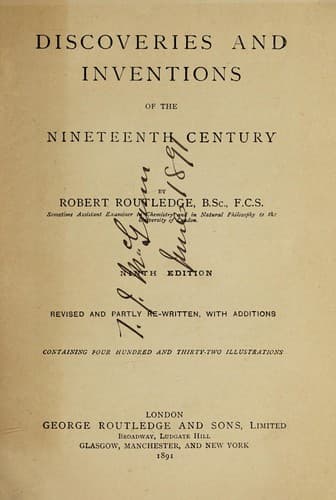
Discoveries and Inventions of the Nineteenth CenturyRoutledge, Robert
History
Discoveries and Inventions of the Nineteenth Century
Routledge, Robert
Inventions -- History -- 19th century
will be 600 feet by 80 feet, the middle one 350 feet by 50 feet, and the
smallest one 150 feet by 30 feet. These three locks will be separated by
concrete piers 30 feet wide, on which will be placed the hydraulic
machinery for opening and closing the gates. Besides the ordinary gates,
there will be provided for each lock at Eastham an outer pair of
storm-gates that will be closed only in rough weather. These gates will
shut from the outside against the lock sills, and, by resisting the
force of wind and waves, will protect the ordinary tidal gates from
being forced open. The lock gates throughout will be made of a wood
obtained from British Guiana, and known as _greenheart_. This timber is
the product of a large tree (_Nectandra Rodiœi_) belonging to the laurel
family. It is a very heavy and close grained wood, the strength and
endurance of which have been proved many years ago by its use in
ship-building, etc., and some of the logs imported for the canal are
remarkably fine specimens, being 22 inches square and 60 feet long. A
pair of the largest gates weigh about 500 tons. The gates of the tidal
locks at Eastham will all be open for half the time of each tide, when
there will be a depth of water, above the sills, greater by 11 feet than
that of any dock in Liverpool or Birkenhead.
[Illustration:
FIG. 137.—_Manchester Ship Canal Works, Runcorn._
]
The way in which the difficulty is overcome of crossing the several busy
lines of railway that intersect the course of the new canal, so that
their traffic shall not be impeded, is one of special interest in this
bold scheme. The London and North Western Railway crosses the Mersey at
Runcorn by a bridge that leaves a clear headway of 75 feet at high
water, and it was determined that this headway should be maintained in
the bridges over the canal. The use of swing bridges on lines of railway
over which trains are constantly passing being out of the question, it
is necessary that the railways be carried over the canal at the required
height. It is accordingly laid down in the Act of Parliament that before
the Canal Company can cut the existing lines of railway it shall
construct permanent bridges, and carry over them lines rising by
gradients not exceeding 1 in 135, and not only so, but these deviation
lines must be previously given up to the several railway companies for
six months to be tried experimentally in that period for goods traffic.
The cost of constructing these deviation lines, which, in all, will not
be far short of 12 miles of new railway, will not be much less than
£500,000. The traffic of the canal will probably have great feeders at
certain points in the other canals and the railway lines that reach it.
For instance, the Bridgewater Canal, now incorporated with the greater
undertaking, will bring traffic from the Staffordshire potteries, the
river Weaver brings salt laden barges from Cheshire, and at other points
the railways will bring the produce of the excellent coal fields of
Public-domain text, read in full here on John Shaqi.
Reviews
Reviews
No reviews yet
Be the first to share your thoughts on this work.
Elsewhere in the archive
Join the Discussion
Join the discussion
Sign in to leave a comment or review.
Sign InorCreate an account