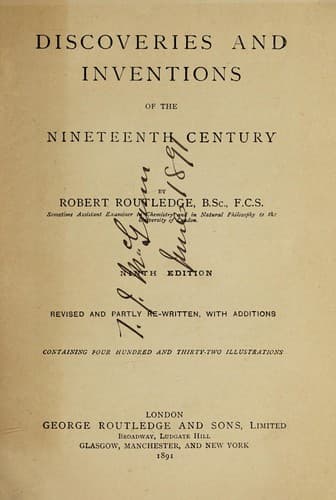
Discoveries and Inventions of the Nineteenth CenturyRoutledge, Robert
History
Discoveries and Inventions of the Nineteenth Century
Routledge, Robert
Inventions -- History -- 19th century
Before the invention of the steam hammer, large forge hammers had been
in use actuated by steam, but in an indirect manner, the hammer having
been lifted by cams and other expedients, which rendered the apparatus
cumbersome, costly, and very wasteful of power, on account of the
indirect way in which the original source of the force, namely, the
pressure of the steam, had to reach its point of application by giving
the blow to the hammer. Not only did the necessary mechanism for
communicating the force in this roundabout manner interfere with the
space necessary for the proper handling of the article to be forged, but
the range of the fall of the hammer being only about 18 in., caused a
very rapid decrease in the energy of the blow when only a very
moderate-sized piece of iron was introduced. For example, a piece of
iron 9 in. in diameter reduced the fall of the mass forming the hammer
to one-half, and the work it could accomplish was diminished in like
proportion. Besides, as the hammer was attached to a lever working on a
centre, the striking face of the hammer was parallel to the anvil only
at one particular point of its fall; and again, as the hammer was always
necessarily raised to the same height at each stroke, there was
absolutely no means of controlling the force of the blow. When we
reflect on the fact that the rectilinear motion of the piston in the
cylinder of the engine had first to be converted into a rotary one, by
beams, connecting-rod, crank, &c., and then this rotary movement
transformed into a lifting one by the intervention of wheels, shafts,
cams, &c., while all that is required in the hammer is a straight
up-and-down movement, the wonder is that such an indirect and cumbersome
application of power should have for so many years been contentedly
used. But in November, 1839, Mr. Nasmyth, an eminent engineer of
Manchester, received a letter from a correspondent, informing him of the
difficulty he had found in carrying out an order received for the
forging of a shaft for the paddle-wheels of a steamer, which shaft was
required to be 3 ft. in diameter. There was in all England no forge
hammer capable of executing such a piece of work. This caused Mr.
Nasmyth to reflect on the construction of forge hammers, and in _a few
minutes_ he had formed the conception of the steam hammer. He
immediately sketched the design, and soon afterward the steam hammer was
a _fait accompli_, for Mr. Nasmyth had one at once executed and erected
at his works, where he invited all concerned to come and witness its
performances. Will it be believed that four years elapsed before this
admirable application of steam power found employment outside the walls
of Mr. Nasmyth’s workshops? After a time he succeeded in making those
best able to profit by such an invention aware of the new power—for such
it has practically proved itself, having done more to revolutionize the
manufacture of iron than any other inventions that can be named, except,
Public-domain text, read in full here on John Shaqi.
Reviews
Reviews
No reviews yet
Be the first to share your thoughts on this work.
Elsewhere in the archive
Join the Discussion
Join the discussion
Sign in to leave a comment or review.
Sign InorCreate an account