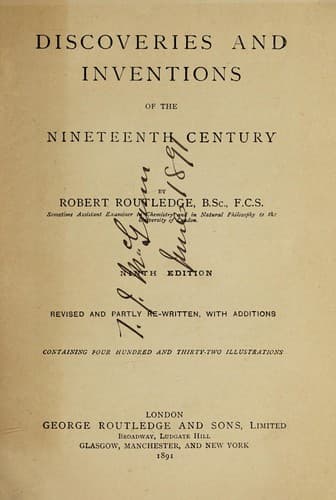
Discoveries and Inventions of the Nineteenth CenturyRoutledge, Robert
History
Discoveries and Inventions of the Nineteenth Century
Routledge, Robert
Inventions -- History -- 19th century
perhaps, those of Cort and Bessemer. The usual prejudice attending the
introduction of any new machine, however obvious its advantages are
afterward admitted to be, at length cleared away, and the steam hammer
is from henceforth an absolute necessity in every engineering workshop,
and scarcely less so for some of the early stages of the process of
manufacturing crude wrought iron. Whether blows of enormous energy or
gentle taps are required, or strokes of every gradation and in any
order, the steam hammer is ready to supply them.
[Illustration:
FIG. 13.—_Nasmyth’s Steam Hammer._
]
A steam hammer of the smaller kind is represented in Fig. 13. The
general mode of action will easily be understood. The steam is admitted
below the piston, which is thus raised to any required height within the
limits of the stroke. When the communication with the boiler is shut off
and the steam below the piston is allowed to escape, the piston, with
the mass of iron forming the hammer attached to the piston-rod, falls by
its own weight. This weight, in the large steam hammers, amounts to
several tons; and the force of the blow will depend jointly upon the
weight of the hammer, and upon the height from which it is allowed to
fall. The steam is admitted and allowed to escape by valves, moved by a
lever under the control of a workman. By allowing the hammer to be
raised to a greater or less height, and by regulating the escape of the
steam from beneath the piston, the operator has it in his power to vary
the force of the blow. Men who are accustomed to work the valves can do
this with great nicety. They sometimes exhibit their perfect control
over the machine by cracking a nut on the anvil of a huge hammer; or a
watch having been placed—face upwards—upon the anvil, and a moistened
wafer laid on the glass, a practised operator will bring down the
ponderous mass with such exactitude and delicacy that it will pick up
the wafer, and the watch-glass will not even be cracked. The steam
hammer has recently been improved in several ways, and its power has
been more than doubled, by causing the steam, during the descent, to
enter above the piston and add its pressure to the force of gravity.
Probably one of the most powerful steam hammers ever constructed is that
recently erected at the Royal Gun Factory at Woolwich, for the purpose
of forging great guns for the British Navy. It has been made by Nasmyth
& Co., and is in shape similar to their other steam hammers. Its height
is upwards of 50 ft., and it is surrounded with furnaces and powerful
cranes, carrying the huge iron tongs that are to grasp the glowing
masses. The hammer descends not merely with its own weight of 30 tons;
steam is injected behind the falling piston, which is thus driven down
with vastly enhanced rapidity and impulse. Of the lower portion of this
stupendous forge, nothing is visible but a flat table of iron—the
anvil—level with the floor of the foundry. But more wonderful, perhaps,
Public-domain text, read in full here on John Shaqi.
Reviews
Reviews
No reviews yet
Be the first to share your thoughts on this work.
Elsewhere in the archive
Join the Discussion
Join the discussion
Sign in to leave a comment or review.
Sign InorCreate an account