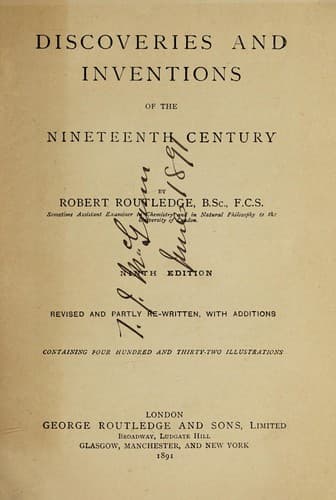
Discoveries and Inventions of the Nineteenth CenturyRoutledge, Robert
History
Discoveries and Inventions of the Nineteenth Century
Routledge, Robert
Inventions -- History -- 19th century
combination give rise to 500° of heat, when the same combine, at say the
initial temperature of 400°, the result would be a temperature of 900°;
if burnt at this latter degree, then 900° + 500° would be reached, and
so on. It would seem as if there were no limit to the temperatures
obtainable in this way. But the nature of the materials of which the
furnace is constructed imposes a limit, for even the most refractory
matters yield at length, and the working would come to an end by the
fusing of the brickwork. The diagram is a section through the length of
the hearth (for it is usually oblong in plan), and the low arch above H
being exposed to the fiercest heat, is formed of the most refractory
“silica bricks,” that is, bricks made of coarsely ground silica held
together with a little lime; yet this extremely resisting material is
acted upon, and the arch has to be renewed every few months or sometimes
weeks. The hearth itself is supported by massive iron plates, shown in
the diagram by the thick lines, above which is laid a deep bed L, of
quartz sand or ganister, or where required a _basic_ lining, beaten hard
down, and forming a kind of basin with sides sloping down in all
directions to a point immediately below the centre of the fire-brick
door D, where is the aperture for tapping, stopped by a mixture of sand
and clay until the metal is ready for drawing off, when it runs outside
into an iron spout lined with sand and is received into the ingot
moulds. B in the figure represents the “bath,” as it is called, of
molten metal, which, in the larger furnaces, where 20 tons of metal is
operated on at once, may occupy an area of 150 square ft.
It need hardly be mentioned that there has to be a certain adjustment
between the volumes of air and of gas that pass into the regenerative
stoves, in order that the best effect may be obtained. Besides the limit
of temperature occasioned by the nature of the materials, there is a
chemical reason why the regenerative stoves cannot increase the
temperature indefinitely. It is noticed that when the temperature of the
furnace has become very high indeed, the flame over the hearth assumes a
peculiar appearance, being interrupted by dark spaces. These are
attributable to what is called in chemistry “dissociation,”—in this case
the dissociation of carbonic acid gas, which by the heat alone separates
into carbonic oxide and oxygen gases. In the same way these gases refuse
to combine if brought together heated beyond a certain temperature. This
phenomenon of dissociation is a general one, for it is found that for
any pair of substances there is a characteristic range of temperature
above or below which they refuse to combine. The gas used in these
stoves is either unpurified coal gas, or that produced by passing steam
over red-hot coal or coke.
Public-domain text, read in full here on John Shaqi.
Reviews
Reviews
No reviews yet
Be the first to share your thoughts on this work.
Elsewhere in the archive
Join the Discussion
Join the discussion
Sign in to leave a comment or review.
Sign InorCreate an account