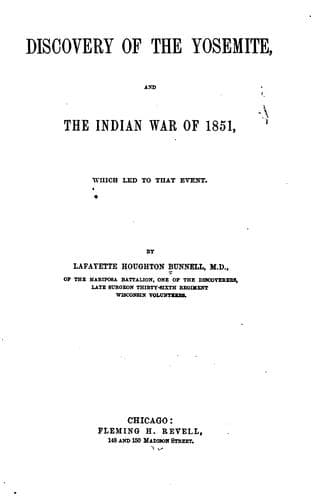
Discovery of the Yosemite, and the Indian War of 1851, Which Led to That EventBunnell, Lafayette Houghton
History
Discovery of the Yosemite, and the Indian War of 1851, Which Led to That Event
Bunnell, Lafayette Houghton
Indians of North America -- California; Pacific Coast Indians, Wars with, 1847-1865; Yosemite Valley (Calif.)
The energetic Lieutenant was our most rigid disciplinarian when on
duty. His fearless impetuosity in the execution of all his duties,
made him a favorite with the more reckless spirits; his blunt and
earnest manner excited their admiration; for, though possessed of a
sublime egotism, he was entirely free from arrogance. Instead of his
usual cheerful and agreeable conversation, he was almost morosely
taciturn; he refilled his capacious mouth with choice Virginia, and
settled back against the wood-pile. After listening to us for a while,
he said: “I am heartily sick of this Quaker-style of subduing Indians.
So far,--since our muster-in--we have had plenty of hard work and
rough experience, with no honor or profit attending it all. We might
as well be armed with clubs like any other police.” There was none in
our group disposed to dispute the assertion of Chandler. As a body, we
were anxiously desirous of bringing the Indian troubles to a close as
soon as it could be practically accomplished. Many of us had suffered
pecuniarily from the depredations of these Mountain tribes, and had
volunteered to aid in subduing them, that we might be able to resume
our mining operations in peace. Many of us had left our own profitable
private business to engage in these campaigns for the public good,
expecting that a vigorous prosecution of the war would soon bring it to
a close. I will here say that some sensational newspaper correspondents
took it upon themselves to condemn this effort made by the settlers
to control these mountain tribes, which had become so dangerous;
charging the settlers with having excited a war, and to have involved
the government in an unneccessary expense, for the purpose of reaping
pecuniary benefits; and that our battalion had been organized to afford
occupation to adventurous idlers, for the pay afforded. Knowing the
ignorance that obtains in regard to real Indian character, and the
mistaken philanthropy that would excuse and probably even protect and
lionize murderers, because they were _Indians_; but little attention
was at first paid to these falsely slanderous articles, until one was
published, so personally offensive, and with such a false basis of
statement, that Captain Boling felt it his duty to call for the name of
its author. His name was given by the editor of the paper on a formal
demand being made. The Captain then _intimated_ through a friend, that
a public retraction of the article was desirable. In due time, the
Captain received a very satisfactory apology, and a slip of a published
retraction of the offensive correspondence. The investigation developed
the fact that the writer--who was an Eastern philanthropist--had been
played upon by certain parties in Stockton, who had failed to get the
contract to supply the battalion.
Public-domain text, read in full here on John Shaqi.
Reviews
Reviews
No reviews yet
Be the first to share your thoughts on this work.
Elsewhere in the archive
Join the Discussion
Join the discussion
Sign in to leave a comment or review.
Sign InorCreate an account