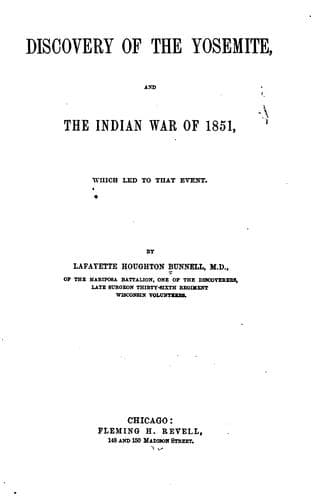
Discovery of the Yosemite, and the Indian War of 1851, Which Led to That EventBunnell, Lafayette Houghton
History
Discovery of the Yosemite, and the Indian War of 1851, Which Led to That Event
Bunnell, Lafayette Houghton
Indians of North America -- California; Pacific Coast Indians, Wars with, 1847-1865; Yosemite Valley (Calif.)
by the Pyrenians flashed through my mind, and I could readily see how
destructive such an attack might become.
After taking the precaution to secrete the baskets on the main trail,
Lt. Gilbert, with his scouts, continued his explorations in other
localities, saying as he left that he would warn all whom he might
see “not to get into the trap.” I mounted my mule and rode down the
valley in search of Captain Boling, and found him in an oak grove near
our old camp, opposite a cliff, now known as “Hammo” (the lost arrow).
I here learned the particulars of his successful capture of the five
scouts of Ten-ie-ya’s band, and at his request asked them, through
Sandino, who had come over with the “_kitchen mules_,” why they had so
exposed themselves to our view. They replied that Ten-ie-ya knew of our
approach before we reached the valley. That by his orders they were
sent to watch our movements and report to him. That they did not think
we could cross the Merced with our horses until we reached the upper
fords; and therefore, when discovered, did not fear. They said that
Ten-ie-ya would come in and “have a talk with the white chief when he
knows we are here.”
After repeated questioning as to where their people were, and where the
old chief would be found if a messenger should be sent to him, they
gave us to understand that they were to meet Ten-ie-ya near To-co-ya,
at the same time pointing in the direction of the “North Dome.” Captain
Boling assured them that if Ten-ie-ya would come in with his people he
could do so with safety. That he desired to make peace with him, and
did not wish to injure any of them. The young brave was the principal
spokesman, and he replied: “Ten-ie-ya will come in when he hears what
has been said to us.”
Having acquired all the information it was possible to get from
the Indians, Capt. Boling said that in the morning he would send a
messenger to the old chief and see if he would come in. When told
this the young “brave” appeared to be very anxious to be permitted to
go after him, saying: “He is there now,” pointing towards the “North
Dome,” “another day he will be on the ‘Skye Mountains,’ or anywhere,”
meaning that his movements were uncertain.
Public-domain text, read in full here on John Shaqi.
Reviews
Reviews
No reviews yet
Be the first to share your thoughts on this work.
Elsewhere in the archive
Join the Discussion
Join the discussion
Sign in to leave a comment or review.
Sign InorCreate an account