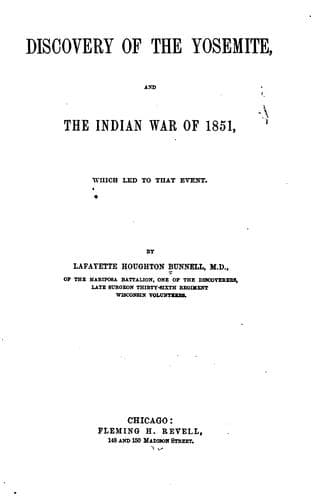
Discovery of the Yosemite, and the Indian War of 1851, Which Led to That EventBunnell, Lafayette Houghton
History
Discovery of the Yosemite, and the Indian War of 1851, Which Led to That Event
Bunnell, Lafayette Houghton
Indians of North America -- California; Pacific Coast Indians, Wars with, 1847-1865; Yosemite Valley (Calif.)
A few took advantage of this opportunity and made excursions up the
North Cañon to the “basket trail,” with a view of examining that
locality, and at the same time indulging their curiosity to see the
place where Cameron and Spencer had been trailed in and entrapped by
the Indians. Most of the command preferred to remain in camp to repair
damages, rest, and to amuse themselves in a general way. Among the
recreations indulged in, was shooting at a target with the bows and
arrows taken from the captured Indians. The bow and arrows of the
young brave were superior to those of the others, both in material
and workmanship. Out of curiosity some of the boys induced him to
give a specimen of his skill. His shots were really commendable. The
readiness with which he handled his weapons excited the admiration
of the lookers on. He, with apparent ease, flexed a bow which many
of our men could not bend without great effort, and whose shots were
as liable to endanger the camp as to hit the target. This trial of
skill was witnessed by Captain Boling and permitted, as no trouble was
anticipated from it.
After this exercise had ceased to be amusing, and the most of those in
camp had their attention engaged in other matters, the guard, out of
curiosity and for pastime, put up the target at long range. To continue
the sport it was necessary to bring in the arrows used, and as it
was difficult to find them, an Indian was taken along to aid in the
search. The young brave made a more extended shot than all others. With
great earnestness he watched the arrow, and started with one of the
guard, who was unarmed, to find it. While pretending to hunt for the
“lost arrow,” he made a dash from the guard toward “Indian Cañon,” and
darted into the rocky Talus, which here encroached upon the valley. The
guard on duty hearing the alarm of his comrade and seeing the Indian
at full speed, fired at him, but without effect, as the intervening
rocks and the zig-zag course he was running, made the shot a difficult
one, without danger of hitting his comrade, who was following in close
pursuit.
Public-domain text, read in full here on John Shaqi.
Reviews
Reviews
No reviews yet
Be the first to share your thoughts on this work.
Elsewhere in the archive
Join the Discussion
Join the discussion
Sign in to leave a comment or review.
Sign InorCreate an account