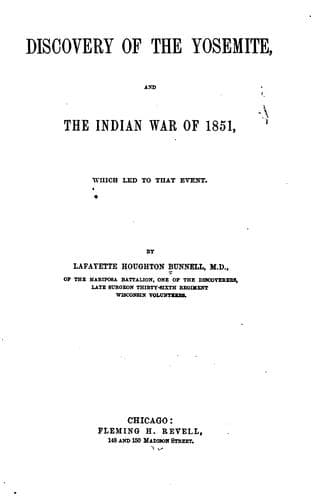
Discovery of the Yosemite, and the Indian War of 1851, Which Led to That EventBunnell, Lafayette Houghton
History
Discovery of the Yosemite, and the Indian War of 1851, Which Led to That Event
Bunnell, Lafayette Houghton
Indians of North America -- California; Pacific Coast Indians, Wars with, 1847-1865; Yosemite Valley (Calif.)
As Ten-ie-ya was brought into the presence of Capt. Boling by Sergt.
Cameron, after this attempt to escape, he supposed that he would now he
condemned to be shot. With mingled fear of the uncertainty of his life
being spared, and his furious passion at being foiled in his attempt
to regain his liberty, he forgot his usual reserve and shrewdness. His
grief for the loss of his son and the hatred he entertained toward
Capt. Boling, who he considered as responsible for his death, was
uppermost in his thoughts, and without any of his taciturn, diplomatic
style he burst forth in lamentations and denunciations, given in a loud
voice and in a style of language and manner of delivery which took
us all by surprise. In his excitement, he made a correct use of many
Spanish words, showing that he was more familiar with them than he had
ever admitted even to Sandino; but the more emphatic expressions were
such as may often be heard used by the muleteers of Mexico and South
America, but are not found in the Lexicons. As he approached Capt.
Boling, he began in a highly excited tone: “_Kill me_, sir Captain!
Yes, _kill me_, as you killed my son; as you would kill my people if
they were to come to you! You would kill all my race if you had the
power. Yes, sir, American, you can now tell your warriors to kill the
old chief; you have made me sorrowful, my life dark; you killed the
child of my heart, why not kill the father? But wait a little; when I
am dead I will call to my people to come to you, I will call louder
than you have had me call; that they shall hear me in their sleep,
and come to avenge the death of their chief and his son. Yes, sir,
American, my spirit will make trouble for you and your people, as you
have caused trouble to me and my people. With the wizards, I will
follow the white men and make them fear me.” He here aroused himself
to a sublime frenzy, and completed his rhapsody by saying: “You may
kill me, sir, Captain, but you shall not live in peace. I will follow
in your foot-steps, I will not leave my home, but be with the spirits
among the rocks, the water-falls, in the rivers and in the winds;
wheresoever you go I will be with you. You will not see me, but you
will fear the spirit of the old chief, and grow cold.[13] The great
spirits have spoken! I am done.”
Public-domain text, read in full here on John Shaqi.
Reviews
Reviews
No reviews yet
Be the first to share your thoughts on this work.
Elsewhere in the archive
Join the Discussion
Join the discussion
Sign in to leave a comment or review.
Sign InorCreate an account